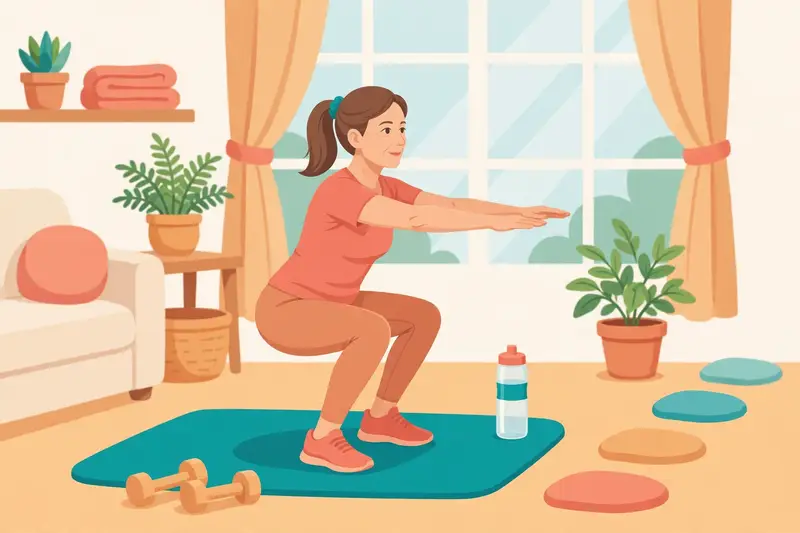
If you have been thinking about starting a home workout routine, you are not alone. I hear from women in their forties, fifties, and sixties all the time who tell me the same thing: they want to feel stronger, move more easily, and have more energy, but they are not sure where to begin. Maybe it has been years since you exercised regularly. Maybe you have tried a class or a video before and felt lost, or sore, or just out of place. Maybe life got busy, and somewhere along the way, moving your body stopped being part of your day.
Here is what I want you to know first: you do not need to be fit to start. You do not need special equipment, a spare room, or an hour a day. You need a plan that starts where you actually are, builds slowly, and lets you feel a small win every single week. That is exactly what this four-week plan is designed to do.
I put this plan together for women who are starting from the beginning, or starting over after a long break. Every workout is designed to be done at home, with no equipment at all, or with things you already have around the house, like a sturdy chair and a wall. Each week adds just a little more, so your body has time to adapt and your confidence has time to grow. By the end of four weeks, you will have a routine that feels like yours, and you will know exactly how to keep going.
How This 4-Week Plan Works
The plan is built around three workout days a week, with rest or gentle movement days in between. That rhythm matters. When you are new to exercise, your body needs time to recover and rebuild between sessions. Three days a week is enough to build real strength and stamina, and it leaves plenty of room in your life for everything else.
Each week has a theme. Week one is about getting moving and learning the basic moves. Week two adds a little strength work and a little more time. Week three focuses on making the habit stick, because consistency is what turns a plan into a routine. Week four pulls everything together into a balanced weekly schedule you can repeat and build on.
Every workout follows the same simple shape: a short warm-up, a main section of movement, and a cool-down with gentle stretching. Once you learn that shape, you will never feel lost at the start of a session again. You will know what comes next, and that makes it so much easier to begin.
The workouts are short on purpose. Most take twenty to thirty minutes, and week one starts even shorter. A short workout you actually do beats a long workout you keep putting off. If you finish a session and feel like you could do a little more, that is a good sign. It means the plan is working at the right level for you, and you can add more when week two arrives.
One more thing before we start. If you have a health condition, an injury, or any concern about exercising, please check with your doctor before beginning this or any new routine. A quick conversation with your doctor can help you know which moves to adjust and what signs to watch for, and it gives you real peace of mind as you get started.
What You Need to Start
You need very little to begin this plan, and that is by design. A clear patch of floor about the size of a yoga mat, a pair of comfortable shoes or bare feet on a non-slip surface, and clothes you can move in are enough for week one. If you have a sturdy chair, keep it nearby for balance during standing moves.
A bottle of water is worth having within reach for every session. Keep a towel handy too, especially as the workouts get a little longer. If you have a yoga mat, great, but a rug or carpet works just as well for the floor moves. You do not need dumbbells yet. Your own body weight is plenty of resistance when you are starting out.
It also helps to pick a regular time of day for your workouts. Some women love the quiet of the early morning, before the house wakes up. Others feel best in the late afternoon, when they need a break from sitting. There is no right answer. The best time is the one you can protect most days. If mornings work for you, a simple morning workout routine for women at home can be a lovely way to start the day, and you can build on that habit as the weeks go on.
Finally, grab a notebook or open a note on your phone. You will use it to jot down how each workout felt, which moves were hard, and what you noticed about your energy and mood. This little log becomes your own record of progress, and it is more motivating than you might expect.
Week 1: Getting Moving
Week one is all about showing up and learning the moves. The goal is not to push hard. The goal is to finish each session feeling pleasantly tired, not exhausted, and to wake up the next day looking forward to the next one rather than dreading it.
Your week one schedule is three sessions: Monday, Wednesday, and Friday. Each session takes about twenty minutes. On the days between, take a gentle walk if you feel like it, or simply rest. There is no homework in week one beyond moving a little and noticing how your body feels.
Week 1 Workout: Monday, Wednesday, and Friday
Warm up for five minutes with a slow march in place, gentle arm circles, and a few easy shoulder rolls. Move slowly and breathe normally. The warm-up is not a test. It is a signal to your body that it is time to move.
Then move through this circuit, doing each move for thirty seconds, resting for thirty seconds between moves, and resting for one minute at the end of the circuit. Repeat the circuit twice.
- March in place, lifting your knees a little higher each time, for thirty seconds.
- Wall push-ups, standing an arm's length from a wall, hands flat against it, for thirty seconds.
- Chair-assisted squats, sitting back toward a chair and standing up again, for thirty seconds.
- Standing side steps, stepping out to each side with a small bend in the knees, for thirty seconds.
- Seated or standing arm raises, lifting both arms overhead and lowering them slowly, for thirty seconds.
Finish with a five-minute cool-down: slow walking around the room, then gentle stretches for your neck, shoulders, arms, and legs. Hold each stretch for about twenty seconds and breathe deeply. Stretching should feel like a gentle pull, never a sharp pain.
If a move feels too hard, make it smaller. March with lower knees. Do wall push-ups with your feet closer to the wall. Squat only partway down. There is no prize for doing the hardest version on day one. The prize is coming back on Wednesday.
Week 2: Adding Strength
By week two, your body has had a taste of regular movement, and you may notice small changes already. Maybe you feel a little less stiff in the morning. Maybe the stairs feel a touch easier. Maybe you simply feel proud of yourself for keeping three appointments with yourself. All of that counts.
This week we add a little more time and a little more strength work. The sessions grow to about twenty-five minutes, and we introduce two new moves: a standing glute bridge alternative done on the floor, and a gentle plank on your knees. Do not worry if the plank feels hard at first. Most people find it challenging, and it gets easier faster than you would think.
Your week two schedule is still Monday, Wednesday, and Friday. On Tuesday or Thursday, add a ten-minute walk after lunch or dinner if you can. Walking is one of the kindest and most effective forms of movement there is, and it pairs beautifully with strength work. If you want to understand why, my article on walking for weight loss for women explains how a simple daily walk supports your energy, your mood, and your overall fitness.
Week 2 Workout: Monday, Wednesday, and Friday
Warm up for five minutes, the same as week one, adding a few gentle torso twists and slow leg swings if they feel good. Then move through the circuit below, doing each move for forty seconds with twenty seconds of rest between moves. Rest for one minute at the end, and repeat the circuit twice.
- March in place with higher knees, for forty seconds.
- Wall push-ups, now with your feet a little farther from the wall, for forty seconds.
- Chair squats, sitting back a little lower than last week, for forty seconds.
- Standing side steps with a gentle arm swing, for forty seconds.
- Floor glute bridge, lying on your back with knees bent and lifting your hips, for forty seconds.
- Knee plank, holding your body in a straight line from knees to head, for twenty to thirty seconds.
Cool down for five minutes with the same gentle stretches as week one, and add a seated hamstring stretch if you like. Notice how your body feels after the session. A little muscle soreness the next day is normal when you are building strength. It should feel like a dull, even ache that fades within a day or two, not a sharp pain. If something hurts sharply, skip that move and tell your doctor about it.
This week, start your notebook habit if you have not already. After each session, write down three things: which moves felt easier than last week, which move was the hardest, and how your energy felt afterward. In a few weeks, those notes will show you just how far you have come.
Week 3: Building the Habit
Week three is where many people either fall in love with their routine or quietly let it slip. The newness has worn off, and life has a way of getting in the way. That is completely normal, and it is exactly why this week is about the habit itself, not about making the workouts harder.
The workouts stay about the same length as week two, around twenty-five to thirty minutes. The real work this week is protecting your three sessions. Put them in your calendar the way you would put in any other appointment. Lay out your workout clothes the night before. Tell someone in your household that you will be busy for half an hour, and ask them not to interrupt unless it is urgent.
If you miss a session, do not try to make it up by doubling the next one. Just do the next scheduled session as planned. One missed workout does not undo three weeks of work, and beating yourself up about it only makes the next session harder to start. The women who succeed with home workouts are not the ones who never miss a day. They are the ones who miss a day and come back anyway. If you would like more ideas for staying on track, my guide on how to stay consistent with at-home workouts shares practical strategies that have helped many women keep going through busy weeks.
Week 3 Workout: Monday, Wednesday, and Friday
Warm up for five minutes as before. This week, we add one more round to the circuit, so you will complete it three times instead of two. That is the only change, and it is a meaningful one. Three rounds means you are spending more time moving and building more endurance, without learning any new moves.
- March in place with higher knees, for forty seconds.
- Wall push-ups, for forty seconds.
- Chair squats, for forty seconds.
- Standing side steps, for forty seconds.
- Floor glute bridge, for forty seconds.
- Knee plank, holding for twenty to forty seconds.
Cool down for five minutes. This week, also add a short balance practice at the end of one session: stand near a chair or wall and try standing on one foot for ten seconds, then switch sides. Balance is a skill that improves with practice, and it supports everything else you do, from walking on uneven ground to reaching for a high shelf.
On your non-workout days this week, aim for a fifteen-minute walk on at least two days. It does not have to be a brisk power walk. A comfortable, steady pace is perfect. The goal is simply to keep moving on the days between your strength sessions, because regular gentle movement helps your muscles recover and keeps your energy steady.
Week 4: Putting It All Together
Week four is the payoff week. You have learned the moves, built some strength, and practiced showing up. Now we put it all together into a balanced week that looks a lot like a real, lasting fitness routine. You will still work out three days a week, but the sessions will feel different from one another, and that variety keeps things interesting.
Monday is your strength day, using the circuit you already know. Wednesday is a cardio and mobility day, with more marching, stepping, and gentle movement to get your heart rate up. Friday is a mix of strength and balance, and it ends with a longer stretch so you head into the weekend feeling loose and relaxed.
By now, you may be wondering whether you are ready for something a little more challenging. If the circuits feel easy and you finish each session with plenty of energy left, that is a wonderful sign. Hold that thought for the section after week four, where we talk about what comes next. For this week, enjoy the feeling of a routine that fits.
Week 4 Schedule
Monday, strength circuit, about thirty minutes: warm up for five minutes, complete the circuit three times with forty seconds of work and twenty seconds of rest per move, and cool down for five minutes. Use the same six moves from week three, and try to squat a little lower or push a little farther from the wall than you did in week two.
Wednesday, cardio and mobility, about twenty-five minutes: warm up for five minutes, then alternate two minutes of marching in place with one minute of standing side steps, repeating that pattern four times. Add gentle arm circles and shoulder rolls between rounds. Finish with five minutes of stretching, focusing on your hips, calves, and shoulders.
Friday, strength and balance, about thirty minutes: warm up for five minutes, complete the circuit twice, then spend five minutes on balance practice, standing on one foot near a chair, and finish with a longer cool-down of eight minutes, stretching everything from your neck to your ankles. Take your time. Friday is your celebration session.
On Tuesday and Thursday, take a twenty-minute walk if you can. If the weather is bad, walk around your house or march in place while you listen to music or a podcast. The point is gentle movement, not perfection. If you want a little more variety in your cardio days, a beginner-friendly HIIT workout at home for women beginners can be a good next step once you feel comfortable with this plan, because it shows you how to add short bursts of effort safely.
Rest Days and Recovery
Rest days are not wasted days. They are part of the plan, and they are just as important as the workout days. When you exercise, you create tiny amounts of stress in your muscles. It is during rest that your body repairs that stress and comes back a little stronger. Skipping rest does not speed up your progress. It usually slows it down, and it raises the risk of feeling sore, tired, or discouraged.
A good rest day still includes gentle movement. A slow walk, some light stretching while you watch television, or a few minutes of easy marching in place all count. What a rest day should not include is a hard workout in disguise. If you feel tempted to add an extra session, add a walk instead. Your body will thank you.
Sleep is part of recovery too. Aim for a regular bedtime, and notice whether your sleep feels deeper on the days you exercise. Many women tell me they fall asleep more easily once they have a regular movement routine, and that better sleep gives them more energy for the next day's workout. It is a kind cycle, and it starts with something as simple as three short sessions a week.
Pay attention to what your body is telling you. Muscle soreness that fades in a day or two is normal. Joint pain, sharp pain, dizziness, or chest discomfort are not normal, and they are reasons to stop and check with your doctor. Learning to tell the difference between healthy effort and a warning sign is one of the most valuable skills you will build in these four weeks.
Tracking Progress Without Obsessing
Progress comes in many forms, and the scale only measures one of them. In fact, for this four-week plan, I suggest you put the scale away entirely if you can. Your body is adapting in ways a number cannot capture: your muscles are getting stronger, your balance is improving, your stamina is growing, and your mood may be lifting too.
Instead, track the things that tell the real story. Write down how many rounds of the circuit you completed, and how long you could hold the plank. Note whether the chair squats felt easier this week than last week. Record how you slept, how your energy felt in the afternoon, and whether you noticed your clothes fitting a little differently or your posture feeling a little taller.
Once a week, take a moment to read back through your notes. You will be surprised at how much has changed in just a few weeks. That little notebook is your proof that the work is working, and on a day when motivation is low, reading your own words back can be the nudge that gets you moving again.
If you like structure, you can also set one small goal each week. In week one, the goal might simply be to complete all three sessions. In week two, it might be to hold the plank for five seconds longer. In week three, it might be to walk on two rest days. Small goals, kept and celebrated, build the kind of confidence that lasts far longer than any single workout.
Beginner Modifications for Every Move
Every move in this plan can be adjusted to fit your body, and adjusting a move is not cheating. It is smart training. The right version of an exercise is the one you can do with good form, without pain, and repeat again next time. Here are the modifications I recommend most often.
For wall push-ups, the farther your feet are from the wall, the harder the move. Start close, and step back a few inches when it starts to feel easy. If your wrists bother you, try doing the push-ups with your hands on a kitchen counter instead, which changes the angle and often feels kinder on the joints.
For chair squats, use a sturdy chair with armrests if you need extra support getting up and down. Squat only as low as feels comfortable, and focus on keeping your knees pointing in the same direction as your toes. Over time, you will find you can sit back a little lower, and that is real progress.
For the knee plank, if holding your body up on your hands is too much, lower down to your forearms instead. If even that feels hard, try a standing plank with your hands on a wall, holding your body in a straight line. You are still building core strength, and you can move to the floor version when you are ready.
For marching and side steps, you can hold onto a chair or a countertop for balance, and you can keep the steps small. As your balance and confidence improve, let go of the chair for a few steps at a time. If you have knee concerns, keep the steps low and slow, and avoid any move that causes sharp discomfort. A gentle low-impact workout at home for women over 40 is a great companion to this plan, because it shows you how to protect your joints while still getting a satisfying workout.
What to Do After Week 4
Congratulations, you have finished four weeks. Take a moment to be proud of that. You showed up twelve times, learned six moves, built a habit, and gave your body a real foundation. That is no small thing, and it deserves to be celebrated.
Now you have choices. The simplest option is to repeat week four for another two to four weeks, gradually making the moves a little harder. Step a little farther from the wall for push-ups. Squat a little lower. Hold the plank a few seconds longer. Add a fourth round to the circuit when three rounds start to feel comfortable. Small increases, made one at a time, are the safest way to keep improving.
Another option is to add a fourth workout day. You could repeat your favorite session of the week, or add a dedicated walking day with a longer walk of thirty minutes. A fourth day works well for many women once the three-day habit feels solid, but it is not required. Three days a week is a complete and healthy routine on its own.
You might also explore new types of movement now that you have a base. A gentle yoga video, a dance class, a swimming session, or a bike ride can all add variety and joy to your week. The best exercise is the one you enjoy enough to keep doing, so pay attention to what makes you smile. If you find something you love, fold it into your week alongside your strength circuit.
Whatever you choose, keep your notebook going. Keep writing down how you feel, what you did, and what you noticed. Keep protecting your workout appointments. And keep being patient with yourself. Fitness is not a four-week project. It is a way of taking care of yourself that you can carry for years, one small session at a time.
I am cheering for you, and I would love to know how your four weeks went. What surprised you? Which move became your favorite? What do you want to try next? The answers to those questions are the beginning of your next chapter, and I hope you enjoy writing it.
This article is general information for educational purposes only. It is not medical advice, and it is not a substitute for professional help. If you have a health condition, an injury, or any concern about starting a new exercise routine, please talk with your doctor or another qualified health professional before you begin.