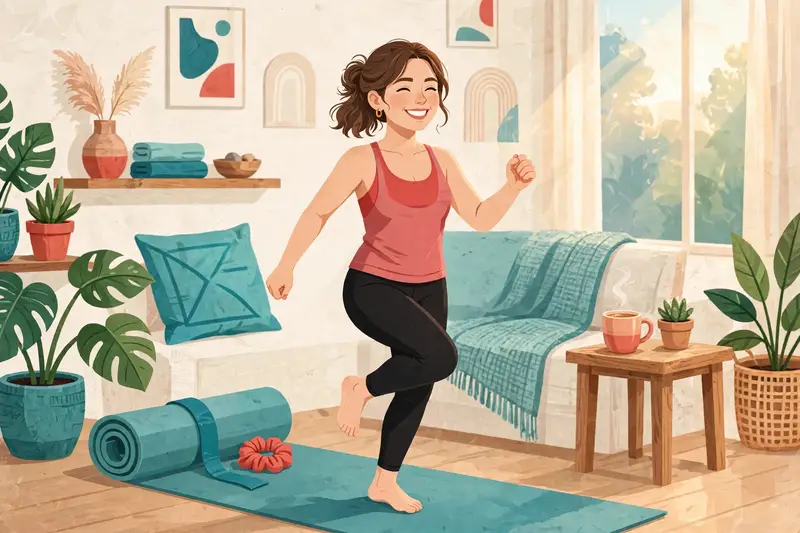
I used to think morning workouts were for other women. You know the ones: up at five, sneakers already laced, smoothie already blended, while the rest of us were still hitting snooze and negotiating with the alarm clock. That was not me. I am not a natural morning person, and for years I told myself that exercise would happen later in the day, after the kids were settled and the work was done. Most days, later never came. By the time evening arrived, I was tired, the couch looked wonderful, and the workout quietly slid to tomorrow. Tomorrow became next week, and next week became next month.
What changed everything for me was a simple, slightly uncomfortable realization: my mornings were the only part of the day nobody else had already claimed. Evenings belonged to dinner, homework, laundry, and everybody else's needs. Mornings, even twenty minutes of them, belonged to me. So I stopped trying to become a five-in-the-morning person and started with something much smaller. I set my alarm fifteen minutes earlier, rolled out of bed, and did ten minutes of stretching and marching in place in my bedroom. That was it. No gym, no equipment, no special clothes. And it worked, not because ten minutes is magic, but because it was so small I could not talk myself out of it.
This is my morning workout routine for women at home: a simple, twenty-minute routine you can do in your living room before the day starts, with no equipment and no experience needed. It is the routine I still use on busy mornings, and it is the one I hand to every woman who tells me she wants to move more but cannot find the time. The time is already there. It is hiding in the first twenty minutes of your day.
Why Mornings Work When Evenings Do Not
There is nothing wrong with evening workouts. If evenings work for you, keep them. But if you have tried evening workouts for months and they keep getting skipped, it is worth asking why. For most of the women I coach, the answer is simple: evenings are unpredictable. A meeting runs late. A child gets sick. Dinner takes longer than planned. You are tired in a way that makes the couch feel like the only reasonable choice. None of that is a failure of willpower. It is just life, and life is louder in the evening than it is at seven in the morning.
Mornings are quieter. The phone has not started buzzing yet. Nobody needs anything from you yet. The house is still, and the day has not had a chance to rearrange your plans. That quiet is the whole advantage. A morning workout does not have to fight for your attention, because your attention has not been spent yet. I have lost count of the women in my free private community who told me the same thing: the workout they do first thing is the workout that actually happens.
There is another benefit that surprised me. On the days I move in the morning, the rest of the day feels different. I drink more water without thinking about it. I make a better breakfast, because I have already done something good for myself and I want to keep the feeling going. I am more patient with my kids and more focused at my desk. None of that is because twenty minutes of exercise transforms a person. It is because starting the day with a small win changes the story you tell yourself about the day. You are not someone who meant to work out. You are someone who already did.
What You Need (Almost Nothing)
Here is the full equipment list for this routine: a clear patch of floor about the size of a yoga mat, a chair or countertop for balance if you want one, and a glass of water. That is all. You do not need dumbbells, bands, or a mat, although a mat is nice if your floor is hard. You do not need workout clothes, although changing out of your pajamas helps some women feel more awake. I have done this routine in leggings, in sweatpants, and, on one memorable morning, in the clothes I slept in, because getting dressed felt like one step too many and I decided that moving mattered more than looking the part.
What you do need is a plan you can follow without thinking. Mornings are not the time for decisions. If you have to stand in your living room wondering what to do next, you will wander back to bed. So the routine below is written to be followed in order, top to bottom, with no choices to make. Print it out and stick it on the fridge, or save it on your phone. When the alarm goes off, you follow the list. Thinking comes later, after the coffee.
If you want a deeper plan for your mornings, my post on five simple tips to rock your early morning workout covers the night-before habits that make mornings easier, like laying out your clothes and deciding your wake-up time the night before. And if you like a challenge with a little structure, my quick early morning 30 day workout challenge is a gentle way to build the habit one morning at a time.
The 20-Minute Morning Routine
Set a timer for twenty minutes and work through the routine in order. Move at a pace that feels comfortable, and rest whenever you need to. There is no score, and nobody is watching. The goal is to finish warm, awake, and a little bit proud of yourself.
Minutes one through five are the warm-up. Start by marching in place for one minute, lifting your knees gently and swinging your arms. Then roll your shoulders backward ten times and forward ten times. Then do ten slow neck rolls, five in each direction, and ten arm circles in each direction. Finish the warm-up with ten slow squats to a chair: stand in front of a sturdy chair, lower yourself until you just touch the seat, and stand back up. If that feels easy, skip the chair. If it feels hard, hold the chair back for balance. By the end of five minutes, your body should feel warm and your breathing a little deeper than when you started.
Minutes five through fifteen are the main circuit. Do each move for forty seconds, rest for twenty seconds, and then move to the next one. The moves are: squats to a chair, wall push-ups, glute bridges lying on your back, step-backs (step one foot back into a small lunge, then switch), and a standing side-step with your arms reaching overhead. Go through the circuit twice. That is ten minutes of steady, honest work, and it trains your legs, your chest, your glutes, and your balance, which is everything a morning routine needs to do.
Minutes fifteen through twenty are the cool-down. Walk slowly around the room for one minute. Then stand tall and reach your arms overhead, holding the stretch for thirty seconds. Then fold forward gently and let your arms hang, holding for thirty seconds. Then sit or lie down and stretch your hamstrings, one leg at a time, for thirty seconds each. Finish with three slow breaths: in through your nose for four counts, out through your mouth for six. Then drink your water, and get on with your day. You just worked out, before most people had their first cup of coffee.
How to Make It Stick
A routine only works if you do it more than once, and mornings are where good intentions go to die. So here is what I have learned about making a morning routine stick. First, start smaller than you think you should. If twenty minutes feels like too much, do ten. If ten feels like too much, do five. A five-minute routine you actually do beats a forty-minute routine you keep skipping. You can always add minutes later. You cannot add them to a routine that does not exist yet.
Second, decide the night before. Before you go to bed, say to yourself: tomorrow I will get up, drink a glass of water, and do my routine. Lay out your clothes. Put your water glass on the counter. Decide where you will do it. Every decision you make the night before is one less decision your sleepy morning brain has to make, and sleepy brains are excellent at talking you out of things. I wrote about this in my post on how to fit exercise into your everyday life, and the message is the same: the habit starts the night before, not the morning of.
Third, tie the routine to something you already do. After you brush your teeth, do your routine. After you let the dog out, do your routine. After the coffee starts brewing, do your routine. Habits stick when they are attached to something that already happens every day, because then you do not need motivation. You just need the trigger. And fourth, give yourself a full month before you judge it. The first week will feel awkward. The second week will feel slightly less awkward. By the fourth week, you will miss it on the mornings you skip it, and that is when you know it is yours.
What to Do on the Hard Mornings
Some mornings will be hard. You slept badly. Your back is stiff. It is cold and dark and the bed is warm. On those mornings, do not try to be heroic. Do the smallest version of the routine: five minutes of marching in place, shoulder rolls, and stretching. That is it. Five minutes still counts, and it keeps the chain unbroken. The chain matters more than any single workout, because the chain is what turns a routine into a habit.
And some mornings, you will skip it entirely. That is fine too. One skipped morning is not a failure, and it does not erase the mornings you did show up. What matters is what you do the next morning. Get up, drink your water, and do the routine again. The women who succeed with morning workouts are not the ones who never miss. They are the ones who miss and come back the next day, without a lecture and without a guilt trip. I have missed plenty of mornings myself, and I am still here, still doing my routine, still starting my days with twenty minutes that belong to me.
If mornings keep slipping away, it can help to have company. My coaching group checks in every morning, and there is something powerful about knowing other women are doing their routine at the same time you are. You do not need a group to start, but you might find that a little accountability is the difference between a routine you try for a week and a routine you keep for a year.
What Comes After the Workout
After the routine, drink a full glass of water before you do anything else. Then eat something with protein. It does not have to be fancy. Eggs and toast, Greek yogurt with berries, or a smoothie with a scoop of protein powder all work. The point is to give your body something real after you asked it to work, and to avoid the trap of working out and then skipping breakfast because you are busy. Breakfast is part of the routine, not an afterthought, and the mornings I eat well are the mornings I feel best all day.
If you want ideas for what to eat, my guides and workbooks include simple breakfast plans, and my post on clean eating meal plan for beginners has a full week of breakfasts, lunches, and dinners that are easy to cook on a busy morning. Keep it simple. The best breakfast is the one you will actually make.
Then go live your day. That is the whole point of a morning workout: it ends, and the day begins, and you carry a little of that early energy with you into everything else. You do not need to think about exercise again until tomorrow morning. It is done. You did it. And tomorrow, the alarm will go off, the house will be quiet, and those twenty minutes will be waiting for you again.
My Honest Take on Morning Workouts
I will not pretend that I love every morning workout. Some mornings I grumble through the whole warm-up. Some mornings the marching in place feels like the hardest thing I will do all day. But I have never once finished a morning routine and wished I had stayed in bed instead. Not once. The feeling after is always the same: awake, steady, and quietly pleased with myself. That feeling is worth twenty minutes, and it is worth the alarm.
So here is my invitation. Tomorrow morning, get up fifteen minutes earlier than usual. Drink a glass of water. March in place for one minute, roll your shoulders, and do ten slow squats to a chair. That is all. Five minutes. Then go about your day and notice how it feels. If it feels good, do it again the next morning, and the next. Add a minute here, a move there, until one day you realize you have a morning workout routine, and you are a woman who works out in the morning. It will not happen overnight, and it does not need to. It just needs to start, and tomorrow morning is a perfectly good place to begin.
This article shares general information and my own experience. It is not medical advice, and it is not a substitute for talking with your doctor, a registered dietitian, or another qualified professional about your own health, especially before you change how you eat or exercise. Every body is different, so please listen to yours and get personal guidance when you need it.