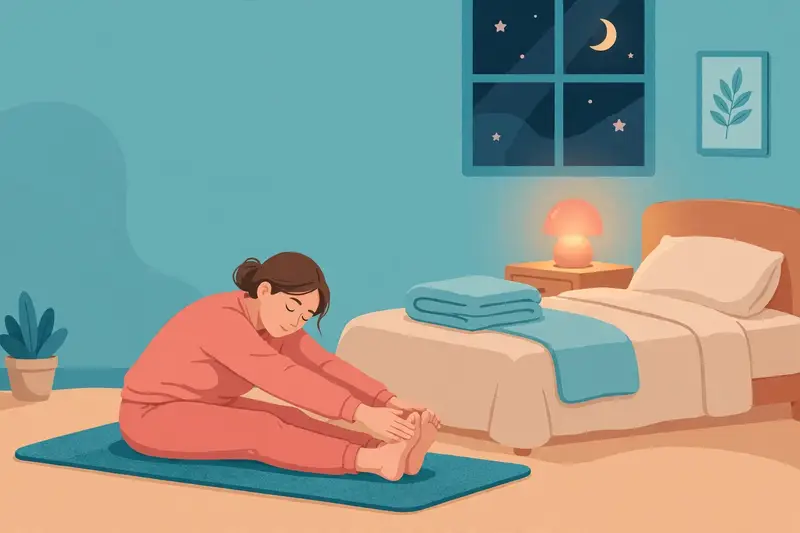
There is a quiet moment at the end of the day when the house finally goes still. The dishes are done, the lights are low, and your body is telling you it is tired — but your mind is still running through tomorrow's list. I know that feeling well, and for years I treated it as something I just had to push through. I would climb into bed wired and restless, toss around for an hour, and then wake up groggy and wonder why I felt so worn out. The change that helped me most was not a new mattress or a fancy gadget. It was ten quiet minutes of stretching on the floor beside my bed.
A gentle stretching routine before bed is one of the simplest habits I teach the women I coach, and it is also one of the most underrated. It does not ask much of you. There is no sweat, no equipment, and no need to change into workout clothes. You simply slow down, breathe, and give your muscles permission to let go of the day. Done regularly, those ten to fifteen minutes can become the signal your body has been waiting for: the day is over, and it is safe to rest now.
In this article, I want to walk you through exactly how I stretch before bed, why it works, and how to make it a habit you actually keep. This is not a workout. It is a wind-down, and the whole point is to feel softer and calmer at the end of it than you did at the start.
Why Stretching Before Bed Helps You Wind Down
Think about what your body has been through by evening. If you spent the day at a desk, your shoulders have been creeping toward your ears for hours. If you were on your feet, your lower back and calves have been carrying you all day. If you worked out, your muscles are warm but tight. If you chased kids or carried groceries or sat in traffic, your body has been holding tension in a dozen small places you probably have not even noticed. Stretching gives all of that tension somewhere to go.
When you stretch slowly, your breathing naturally slows down with it. Long, easy breaths tell your nervous system that the busy part of the day is finished. Your heart rate eases. Your shoulders drop away from your ears. Your jaw unclenches. I have watched women go from wound-up to visibly softer in the space of five slow breaths, and I have felt it in my own body too. The stretch is almost the excuse; the breathing is doing a lot of the quiet work underneath it.
There is also something practical going on. Muscles that stay tight all day tend to stay tight in bed, and tight muscles can make it harder to find a comfortable position to fall asleep in. A few minutes of gentle movement can help your body feel more comfortable when you lie down. You are not trying to become more flexible overnight. You are simply asking your muscles to relax a little before you ask them to rest for seven or eight hours.
For me, the biggest benefit is the boundary it creates. When I roll out my mat — or honestly, just stand on the rug beside my bed — I am drawing a line between the day and the night. The emails can wait. The laundry can wait. For the next ten minutes, the only thing I am doing is breathing and moving slowly. That boundary matters, because so many of us carry the day straight into bed with us and then wonder why sleep does not come easily.
It is worth saying plainly that stretching is not a cure for anything. It will not fix a sleep problem on its own, and it is not a treatment for any condition. What it can do is help you feel calmer and more comfortable as you get ready for bed, and for many of us, that calmer feeling is exactly what makes falling asleep easier. If you have ongoing trouble sleeping, that is something to talk about with your doctor — this routine is a gentle habit, not a medical answer.
What Makes a Good Bedtime Stretching Routine
A bedtime routine is different from a morning or workout stretch, and the difference matters. In the morning, I stretch to wake my body up. Before bed, I stretch to help it settle down. That means everything is slower, softer, and easier. If a stretch feels like work, it is too much for this time of night.
Here are the ground rules I follow, and the ones I give to every woman I coach. First, keep every stretch gentle. You should feel a mild pull, never pain. If you have to hold your breath or grit your teeth, back off. You are aiming for about a five out of ten on the effort scale — enough to feel it, easy enough to breathe through it.
Second, hold each stretch longer than you might in a workout warm-up. I hold most bedtime stretches for thirty to sixty seconds, breathing slowly the whole time. The long hold is what lets the muscle relax instead of just being tugged at. There is no bouncing, no jerking, and no rushing from one position to the next.
Third, breathe through your nose and out through your mouth, slow and steady. Try to make your exhale a little longer than your inhale. I like to count to four as I breathe in and count to six as I breathe out. That slow exhale is one of the most calming things you can do for yourself at the end of the day, and it costs nothing.
Fourth, keep the lights low and the room cool if you can. I do my routine in my pajamas, on the floor beside my bed, with just a lamp on. The idea is to let your body start associating this little ritual with sleep. The more consistent the setting, the stronger that association becomes over time.
Finally, do not turn this into a performance. Some nights you will do the full fifteen minutes. Some nights you will do three stretches and fall into bed. Both count. A short routine you actually do is worth far more than a perfect routine you skip. This is especially true if you are building the habit for the first time — start small, and let it grow.
The Routine: A Gentle 10 to 15 Minute Sequence
This is the routine I use most nights, in this order, moving from the top of the body down. It takes about ten to fifteen minutes if you hold each stretch for thirty to sixty seconds. You do not need a mat, though a rug or carpet is more comfortable than a bare floor. Wear whatever you sleep in. Keep a pillow nearby if you like support under your knees when you lie down.
Move slowly between positions. If something does not feel right in your body, skip it or soften it. This routine is a template, not a test. Your body is different from mine, and the version that works for you is the right version.
Neck and Shoulders: Letting Go of the Day
Start standing or sitting on the edge of your bed, tall and relaxed. Let your arms hang loosely at your sides. Slowly drop your right ear toward your right shoulder, feeling a gentle stretch along the left side of your neck. Hold it for about thirty seconds, breathing slowly. You can rest your right hand lightly on the side of your head for a little extra weight, but do not pull. Then switch sides and hold for another thirty seconds.
Next, roll your shoulders. Lift them up toward your ears, roll them back, and let them drop down. Do this five times, slowly, as if you are shrugging off the whole day. Then roll them forward five times. I like to pair each roll with a breath — in as the shoulders rise, out as they drop. By the third roll, most of the tension I have been carrying starts to melt away.
Now bring your arms behind your back and clasp your hands together, or hold opposite elbows if clasping is not comfortable. Gently lift your hands a few inches away from your back and open your chest. Hold for thirty seconds, breathing into the front of your chest. This is a lovely counter to a day spent hunched over a desk or a phone, and it tends to make the next breath feel deeper and easier.
Finish this section with a slow chin tuck. Sit tall, and gently draw your chin straight back, as if you are making a double chin. Hold for five seconds, release, and repeat five times. It looks silly and feels wonderful, especially if your neck has been craned forward at a screen all day. If your shoulders are often tight after a long day, you may also enjoy a stretching routine for women over 40 that goes into more detail on keeping the shoulders and upper back mobile.
Spine and Side Body: Unwinding the Middle
Come down to the floor or stay seated on your bed for a seated twist. Sit with your legs stretched out in front of you, then bend your right knee and place your right foot flat on the floor outside your left knee. Wrap your left arm around your right knee and place your right hand behind you. Sit tall, breathe in, and as you breathe out, gently twist to the right. Hold for about forty-five seconds, breathing slowly. Then switch sides.
A gentle twist like this can feel like wringing out a washcloth — you are giving your spine a little movement in a direction it may not have moved all day. Keep the twist easy. You should feel it through your middle and into your lower back, but it should never hurt. If twisting is uncomfortable for you, skip it and move on to the next stretch. There is no single move that makes or breaks this routine.
Next, try a seated side stretch. Sit cross-legged or with your legs stretched out, and reach your right arm up and over toward the left, feeling the stretch along your right side. Hold for thirty seconds, then switch. I like to imagine I am making space between my ribs with each breath. This stretch is quiet and simple, and it pairs beautifully with slow breathing.
If you like, finish this section on all fours with a slow cat and cow. On an inhale, let your belly drop and your chest open; on an exhale, round your spine gently toward the ceiling. Move slowly, five rounds, letting the breath lead the movement. This is one of my favorite ways to check in with my body at the end of the day — I can usually tell within two rounds where I am holding tension, and the slow movement helps it soften.
Hips: Releasing Where We Hold Stress
Our hips carry a lot more than we give them credit for. Sitting all day tightens the front of the hips, and standing all day tightens the sides. This section is short, but for many women it is the part of the routine that makes the biggest difference in how comfortable they feel lying down.
Start with a figure-four stretch lying on your back. Bend your knees, cross your right ankle over your left knee, and gently draw your left knee toward your chest. You should feel a stretch deep in your right hip and glute. Hold for forty-five to sixty seconds, breathing slowly, then switch sides. If reaching your knee is hard, you can loop a towel or a belt behind your thigh instead. There is no prize for grabbing your shin — the stretch is what matters, not how you get there.
Next, try a gentle butterfly stretch. Sit with the soles of your feet together and your knees falling open to the sides. Sit tall, hold your feet, and let your knees relax downward. Do not push them. Just let gravity do the work while you breathe for about a minute. If your knees sit high, that is completely fine — place a pillow under each knee for support and let the stretch be easy.
Finally, come into a low lunge if it feels comfortable. Step your right foot forward, lower your left knee to the floor, and rest your hands on your right knee or on blocks or books beside you. Gently shift your weight forward until you feel a stretch in the front of your left hip. Hold for forty-five seconds, then switch. This stretch is wonderful after a day of sitting, and it tends to make the hips feel freer when you lie down afterward.
Legs: Easing the Lower Body
Lie on your back with your knees bent and your feet flat on the floor. Slowly extend your right leg up toward the ceiling, keeping a soft bend in the knee. Hold the back of your thigh or your calf with both hands, and gently draw the leg a little closer until you feel a comfortable stretch along the back of the thigh. Hold for forty-five seconds, breathing slowly, then switch legs. This hamstring stretch is a classic for a reason — tight hamstrings can pull on the lower back, and easing them can help your whole body feel more at ease in bed.
Next, stretch your calves. Stand facing a wall and place your hands on it at shoulder height. Step your right foot back, press your right heel into the floor, and bend your left knee until you feel a stretch in your right calf. Hold for thirty seconds, then switch. If you spend a lot of time on your feet, or if your calves feel tight after walking, this one can be a real relief. I do it almost every night, and it takes less than a minute for both sides.
Finish with a simple legs-up-the-wall pose, which is my favorite way to end the leg section. Lie on your back and scoot close to a wall or the side of your bed, then rest your legs up against it. Your knees can be soft. Rest your arms at your sides, close your eyes, and breathe slowly for one to two minutes. This position feels restful by design — your legs are supported, your heart does not have to work as hard to move blood back up from your feet, and there is nothing to hold or balance. If getting your legs up a wall is tricky, just lying flat on your back with a pillow under your knees gives you much of the same easy feeling.
If your legs often feel heavy or sore after a workout or a long day, a little extra recovery can help too. On the nights when my muscles feel especially worked, I sometimes add a few minutes of gentle foam rolling for muscle recovery at home earlier in the evening, then save the slow stretching for right before bed. The two pair well together — the rolling works on the sore spots, and the stretching helps everything settle.
Breathing and Stillness: The Quiet Finish
The last two minutes of the routine are the simplest and, I would argue, the most important. Lie on your back in a comfortable position, knees bent or legs stretched out, arms resting at your sides with your palms facing up. Close your eyes if that feels comfortable.
Breathe in slowly through your nose for a count of four. Breathe out slowly through your mouth for a count of six. Feel your belly rise on the inhale and fall on the exhale. Let your shoulders sink into the floor. Let your jaw relax. Let your hands uncurl. With each exhale, imagine one part of your body getting a little heavier — your feet, your legs, your hips, your shoulders, your face. There is nowhere else you need to be right now.
If your mind wanders, and it will, that is completely normal. Do not scold yourself. Just notice the thought, let it drift past, and bring your attention back to your breath. I sometimes count my breaths up to ten and then start again at one. If I lose count, I simply start over. There is no score here. The practice is the noticing and the returning, not the perfection.
After about ten slow breaths, stay still for a moment longer. Notice how your body feels compared to when you started. Most nights, I notice that my breathing is slower, my shoulders are lower, and my mind is quieter. That is your cue. Roll gently onto your side, stand up slowly, and climb into bed. Try not to pick up your phone or turn on a bright light at this point — let the calm carry you straight into sleep.
Tips for Making It a Nightly Habit
Knowing a routine is one thing. Doing it every night is another. I have started and abandoned more habits than I can count, so I will share the things that have actually helped me stick with this one, because the routine only helps if it becomes part of your evening.
First, attach it to something you already do. Habits stick best when they ride on the back of an existing routine. For me, stretching happens right after I brush my teeth. The bathroom is on the way to the bedroom, so the sequence is natural: brush teeth, change into pajamas, stretch, climb into bed. You could attach it to washing your face, changing into pajamas, or turning down the bed. Pick the anchor that fits your evening, and do the stretching immediately after it, every night, without negotiating with yourself.
Second, make it easy to start. Keep a clear spot on the floor beside your bed. If you have to move furniture or dig a mat out of a closet every night, you will skip it. I keep a folded blanket on the floor by my bed as my stretching spot. Some nights I use it, some nights I stretch standing up. The point is that starting takes almost no effort — I just step onto the blanket and begin.
Third, keep the bar low at the start. If fifteen minutes feels like too much, do five. Three stretches and ten slow breaths is a complete routine on a busy night. The goal in the first two weeks is not a perfect session. It is simply showing up, night after night, until your body starts to expect it. Once the habit is in place, you can stretch it longer on the nights you have the time and the energy.
Fourth, pair it with something pleasant. I like to do my routine with a soft lamp on and the room quiet, but some women prefer gentle music or a familiar scent, like a lavender pillow spray. Whatever makes the ten minutes feel like a treat rather than a chore will help you come back to it. This is your time. Make it feel like it.
Fifth, track it simply. I keep a small notebook on my nightstand, and I put a check mark on the nights I stretch. That is all. No app, no streak counter, no pressure. But seeing a row of check marks is quietly motivating, and if I miss a night, the blank space reminds me without any guilt attached. Missing a night is not a failure — it is just a night you missed. The next night is a fresh start.
It can also help to pair your stretching with a little reflection. Some nights, after my last few breaths, I think of one thing from the day that went well. It only takes a moment, and it shifts the feeling of the whole day. If you enjoy writing things down, gratitude journaling for a healthier mindset is a gentle practice that fits naturally beside a bedtime stretch, and many of the women I coach find that the two habits support each other.
What to Avoid Late at Night
A bedtime routine works best when the rest of your evening is working with it, not against it. There are a few things I try to avoid in the last hour or two before bed, because they tend to undo the calm that stretching creates.
The biggest one is intense exercise late at night. A hard workout raises your heart rate and your body temperature, and it can leave you feeling alert when you want to feel sleepy. I love a good workout, and I encourage the women I coach to move every day — but I try to finish anything vigorous at least a few hours before bed. If you like to move in the evening, keep it gentle: a slow walk, an easy stretch, or a low-impact workout at home for women over 40 that does not leave you breathless. Save the challenging sessions for the morning or the afternoon.
Bright screens are another one. I know how tempting it is to scroll in bed, and I have done it plenty of times myself. But the light from a phone or a tablet, and the endless stream of news and messages, can keep your mind buzzing long after you put the device down. I try to put my phone on charge across the room about thirty minutes before bed, and I do my stretching in that phone-free window. If you need your phone as an alarm, set the alarm first, then leave the phone alone.
Heavy meals and large amounts of caffeine late in the day can also make it harder to settle. I try to eat dinner at least a couple of hours before bed, and I keep my last cup of coffee to the morning. A small snack is fine if you are hungry — I am not one to go to bed with a growling stomach — but a big, rich meal right before lying down tends to make sleep less comfortable. The same goes for alcohol. A drink in the evening might make you feel drowsy at first, but it can disturb your sleep later in the night, so I keep it modest and early if I have one at all.
Finally, try not to bring the day's worries into the stretching itself. If your mind is racing about tomorrow, you can write the worry down on a piece of paper before you start — just a line or two, enough to park it until morning. Then stretch. The paper will still be there in the morning, and the worry will be easier to face after a night of rest.
Putting It All Together: A Sample Evening
Let me paint a picture of what this looks like on an ordinary night in my house. Dinner is finished and the kitchen is more or less tidy. I change into my pajamas, brush my teeth, and wash my face. I dim the lights in the bedroom and put my phone on the charger across the room. Then I step onto the folded blanket by my bed.
I start with the neck rolls and shoulder rolls, breathing slowly, letting the day slide off my shoulders. Then I sit down for the twist and the side stretch, and I move into the figure-four and butterfly stretches for my hips. I finish the legs with the hamstring stretch and a couple of minutes with my legs up the wall. Then I lie flat, breathe in for four and out for six, and let my body get heavy. The whole thing takes about twelve minutes. Some nights it takes fifteen. Some nights it takes six. It always ends the same way: I stand up slowly, climb into bed, and pull the covers up feeling like I have actually finished the day.
If you are just starting, here is my suggestion for your first week. Night one, do just the neck and shoulder section and the breathing finish — five minutes, and you are done. Night two, add the hip stretches. Night three, add the legs. By the end of the week, you will have the full routine, and it will already feel familiar. There is no rush. Your body is learning a new signal, and signals take a little time to sink in.
And if you miss a night, do not make a big deal of it. Life happens. Late meetings, sick kids, travel, a night out with friends — the routine will be waiting for you the next evening. The women I coach who stick with habits the longest are not the ones who never miss a day. They are the ones who miss a day and simply start again the next night, without the guilt spiral.
One more thing worth mentioning is that sleep and the rest of your health are all connected. The way you sleep affects your energy, your appetite, your mood, and how your body recovers from the day. If you are working on your health — moving more, eating a little cleaner, managing your weight — sleep is part of that picture, not separate from it. I have written about the connection between sleep and weight loss before, and the short version is this: when you sleep better, the healthy choices you make during the day tend to feel easier. A calm bedtime routine supports all of it, quietly, one night at a time.
So tonight, give it a try. Dim the lights, roll your shoulders back, and take ten slow breaths. You do not need special equipment, a perfect body, or a single extra minute of willpower. You just need a small patch of floor, a few quiet minutes, and the willingness to let the day go. Your body has been carrying you all day. Tonight, give it a gentle thank-you, and let it rest.
This article is general information only. It is not medical advice, and it is not a substitute for professional help. If you have a medical condition, an injury, or ongoing trouble sleeping, please talk with your doctor or another qualified health professional before starting a new stretching routine.