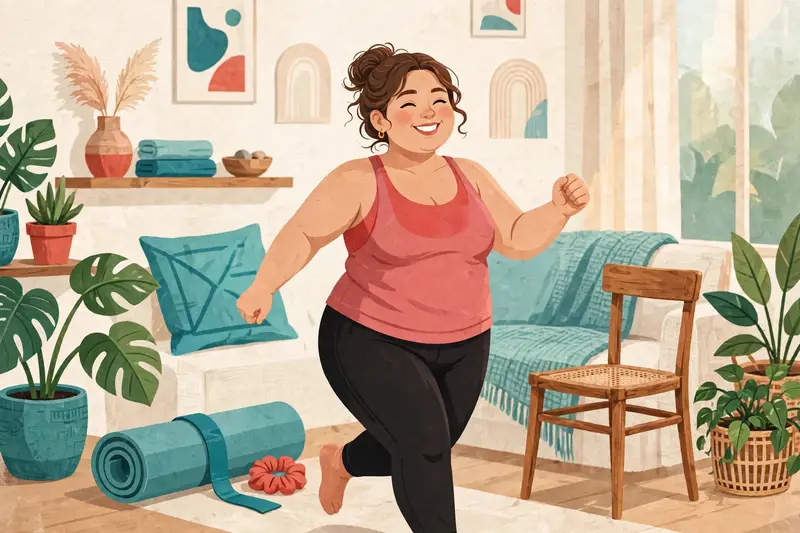
If you are plus size and you have ever typed "beginner workout" into a search bar, you already know the problem. The results are full of women half your size doing jumping jacks on a beach, and the workout assumes you can already do a burpee. It does not assume you need a chair for balance, or that your knees would rather not jump, or that you are starting from zero and you would like someone to say so out loud. So let me say it: this workout is for you, exactly as you are, starting exactly where you are.
I have been writing about plus size fitness for years, because the women I coach are real women with real bodies, and real bodies come in every size. Movement belongs to all of them. You do not need to lose weight before you are allowed to work out. You do not need to earn exercise by shrinking first. You need a routine that respects your body, challenges it gently, and leaves you feeling better than when you started. That is what this article is: a plus-size beginner workout you can do at home, with low-impact moves, chair options, and a four-week plan that starts slow and builds up.
One promise before we begin: nothing in this workout involves jumping, getting down on the floor and back up again quickly, or any move that requires you to be flexible, coordinated, or already fit. Every move has a gentler version, and the gentler version is the real version. You are not doing a watered-down workout. You are doing a workout designed for your body, and that is a different thing entirely.
You Belong Here
Let me say the thing that needs saying, because too many plus-size women have heard the opposite for too long. You belong in fitness. Not after you lose ten pounds. Not when you feel more confident. Now. Your body deserves to be strong, to move well, to feel good in motion, and none of that depends on your size. The fitness world has spent years acting like there is a weight limit on belonging, and that is nonsense. The women in my free private community include women of every size, and the ones who show up, move gently, and keep coming back are the ones who change their lives, whatever the scale says.
I know that starting is the hardest part. It is hard because you have probably tried before, and it is hard because the world has not always been kind about it. So start here, at home, in your living room, with no audience and no judgment. Close the curtains if you want to. Wear what is comfortable. Put on music you love. The only person in the room is you, and you are on your own side. That is the whole point of an at-home workout: it is yours, on your terms, at your pace.
If you want to read more about the mindset that carries women through the early weeks, my post on plus size fitness basics is where I lay it out in full, and my post on plus size fitness newbies: five tips to keep you going is the one I hand to every woman who is starting for the first time. Both were written for you, and both are still true.
Before You Start: The Basics
You need a clear patch of floor, a sturdy chair with no wheels, a bottle of water, and comfortable shoes or bare feet, whichever feels better. That is everything. You do not need a mat, although one is nice if your floor is hard. You do not need weights, bands, or any equipment at all. Your body is the equipment, and it is enough for a beginner workout, because your body is what we are training.
Check in with your doctor before you start a new exercise routine, especially if you have a health condition, joint pain, or you have not exercised in a long time. That is not a warning to scare you. It is the responsible first step, and it is what I tell every woman who starts with me. A quick conversation with your doctor can tell you which moves to favor and which to skip, and it gives you a green light you can feel good about.
Then set up your space. Put the chair on a rug or a non-slip surface so it does not slide. Clear the floor of anything you could trip on. Keep your water within reach. And decide, before you start, that you will stop and rest whenever you need to. Rest is not quitting. Rest is part of the workout, and taking it when you need it is how you finish the workout instead of abandoning it halfway through.
The 20-Minute Beginner Workout
Warm up for five minutes. March in place for two minutes, lifting your knees as high as is comfortable and swinging your arms gently. Then roll your shoulders ten times in each direction, do ten slow neck rolls, and ten gentle torso twists, turning from side to side with your arms relaxed. Finish the warm-up with ten slow sit-to-stands: sit in your chair, stand up slowly using your legs, and sit back down. If standing up without using your hands is hard, push gently on the chair arms. That is a real exercise, and it is the one that will make your legs stronger fastest.
The main workout is a circuit of six moves. Do each one for thirty seconds, rest for thirty seconds, and move to the next. Go through the circuit twice, which takes about twelve minutes. The moves are: sit-to-stands from your chair, wall push-ups (stand facing a wall, place your hands on it, and bend your elbows to bring your chest toward the wall), seated marches (sit tall in your chair and lift one knee at a time), glute bridges (lie on your back with your knees bent, or do them seated by squeezing your glutes), standing side steps (step to the side and back, holding the chair if you need it), and a standing calf raise (rise onto the balls of your feet, hold for a second, and lower slowly).
Every one of these moves has an easier version, and the easier version is the right one if you need it. Sit-to-stands can be done with your hands on the chair. Wall push-ups can be done closer to the wall, with less lean. Seated marches can be done slowly, one knee at a time, with your hands on your thighs. The glute bridge can be a gentle squeeze held for five seconds. The goal is not to do the hardest version. The goal is to do a version you can repeat, three times a week, for a month. That is how strength is built.
Cool down for three minutes. Walk slowly around the room. Reach your arms overhead and hold for thirty seconds. Stretch your calves one at a time, holding the chair for balance. Then sit down, drink your water, and breathe. You just did a workout. It counts, and you should be proud of it.
A 4-Week Plan That Starts Slow
Week one: do the workout twice, with a day of rest in between, and walk for ten minutes on two other days. That is it. Two workouts, two walks. If that feels easy, wonderful, and if it feels like enough, that is wonderful too. Week two: do the workout three times, and walk for fifteen minutes on two other days. Week three: keep the three workouts, and try doing each move for forty seconds instead of thirty. Week four: keep the three workouts, and add a third round of the circuit if you feel ready. If you do not feel ready, do not add it. There is no deadline.
The plan works because it is slow. Slow is not a weakness. Slow is the strategy. The women who quit are usually the ones who tried to do too much in week one, got sore and discouraged, and decided exercise was not for them. The women who succeed are the ones who started with two gentle workouts a week and were still doing them in month three. I have seen it over and over, and it is why I will always tell you to start smaller than you think you should.
If you want a next step after four weeks, my post on building lean muscle and plus size is the natural follow-up, because it explains how to add a little resistance and keep building strength. And my strength training for women over 40 article has a simple three-day plan that pairs well with this workout once you are ready for more. You do not need either of them yet. They will be there when you are.
What to Wear, Where to Move, and Other Practical Things
Wear what is comfortable and what lets you move. For many plus-size women, that means a supportive sports bra, a top that does not ride up, and leggings or shorts that stay where you put them. If you do not have workout clothes you like, regular comfortable clothes are fine. The best workout clothes are the ones you already own and actually wear, and you can buy nicer ones later if you want to.
Move somewhere with a little privacy if that helps you relax, and somewhere with enough space to step to the side without hitting furniture. A living room, a bedroom, a garage, or a back porch all work. If you live with other people, tell them you are doing your workout and ask for twenty minutes of quiet. You are not being demanding. You are taking care of yourself, and that is something the people who love you will understand.
And keep a notebook or a note on your phone. Write down the date, which moves you did, and how you felt. That is all. After four weeks, read it back, and you will see something that no scale can show you: a record of a woman who kept showing up. That record is worth more than any number, and it is the best motivation I know.
The Hard Days
Some days will be hard. Your knees will ache. You will be tired. You will look at the chair and think, not today. On those days, do the smallest version: five minutes of marching in place and shoulder rolls, and then stop. Five minutes keeps the habit alive, and the habit is what matters. Some days you will skip entirely, and that is fine too. One skipped day is not the end of anything. What matters is the next day, when you get up, put on your shoes, and do it again.
If you are struggling with motivation, it helps to have someone in your corner. My coaching group is full of women who started exactly where you are starting, and who will cheer for your first sit-to-stand like it is a marathon finish, because they know it is the same kind of victory. You do not need a group to start, but you might find that belonging to one is what keeps you going when the hard days come.
My Honest Take on Starting at Any Size
Here is what I want you to know, plainly and without a sales pitch. Your body is not a problem to be solved before you are allowed to move. It is the body you live in, and it deserves to be strong, steady, and cared for right now, at this size, on this day. You do not need to wait. You do not need permission. You need a chair, a patch of floor, and twenty minutes. That is all it takes to start, and starting is the hardest part, which means you are almost there already.
So do it this week. Pick two days, set a time, and do the workout. Sit down, stand up, march in place, push against a wall, and breathe. Then write it in your notebook, drink your water, and get on with your day. Next week, do it three times. The week after that, do it again. One day you will realize that you are a woman who works out, and that realization will not come with a fanfare. It will come quietly, in your living room, on an ordinary morning, and it will feel like the most natural thing in the world. Because it is.
This article shares general information and my own experience. It is not medical advice, and it is not a substitute for talking with your doctor, a registered dietitian, or another qualified professional about your own health, especially before you change how you eat or exercise. Every body is different, so please listen to yours and get personal guidance when you need it.