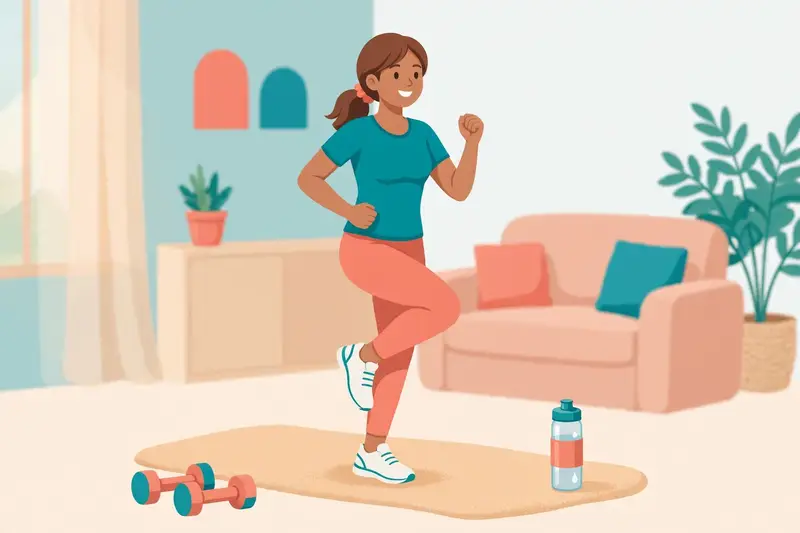
There was a time when I thought a good workout had to leave me breathless, sweaty, and a little bit sore the next morning. If I was not jumping, sprinting, or pushing through burpees, I assumed I was not really working. Then my knees started talking back. Not in a dramatic way, just a quiet ache after a jumping workout, a stiffness in the morning, a reminder that the body I live in now is not the body I had at twenty-five. And honestly, that was a gift, because it pushed me to build a style of training that is just as effective and a whole lot kinder: low-impact HIIT at home.
Low-impact HIIT keeps the heart-pumping, energy-building structure of interval training, but it takes the jumping out. Both feet stay connected to the floor, or at least one foot is always grounded. You still work hard in short bursts, you still rest, and you still finish feeling like you did something real. You just do it without pounding your joints on every rep.
If you have ever avoided interval training because it looked too hard on your knees, your ankles, or your lower back, this workout is for you. It is also for you if you are coming back to exercise after a break, if you are building fitness alongside a walking routine, or if you simply prefer a workout that feels strong without feeling punishing. I use versions of this exact session with women in their forties, fifties, sixties, and beyond, and it works because it respects the body while still challenging it.
In this article, I will walk you through what low-impact HIIT actually is, why it works so well for women working out at home, the moves I trust most, and a complete 20-minute session you can do today in your living room. No equipment is required. No jumping is required. All you need is a little floor space, a chair or wall nearby for balance if you want it, and a timer.
What Low-Impact HIIT Really Means
HIIT stands for high-intensity interval training. In plain language, that means alternating short periods of hard work with short periods of rest or easier movement. You might work for 30 seconds, rest for 30 seconds, and repeat. The intensity is the point. During the work interval, you push yourself. During the rest interval, you recover enough to go again.
Low-impact describes how your body meets the floor. High-impact moves involve both feet leaving the ground at the same time, like jump squats, jumping jacks, and burpees. Low-impact moves keep at least one foot on the ground at all times. Marching in place, stepping side to side, and squatting without a jump are all low-impact. The impact is low, but the effort can still be high. That distinction matters, because many women hear "low-impact" and assume "easy." It is not easy. It is simply gentler on your joints.
Think of it this way: impact is about landing force, and intensity is about effort. You can raise your heart rate, build strength, and work up a real sweat without ever leaving the floor. A fast march with strong arm drive can be every bit as demanding as a slow jog, and a deep, controlled squat can challenge your legs more than a sloppy jump squat ever will.
This is also why low-impact HIIT is such a good fit for home workouts. You do not need a big room, a padded floor, or downstairs neighbors who forgive the thumping. You need a space about the size of a yoga mat, and you can train quietly, early in the morning, without waking the house.
Why This Style Works So Well for Women at Home
There are a lot of reasons I keep coming back to this format, both for myself and for the women I coach. The first is that it is efficient. Twenty minutes is enough. You do not need an hour in a gym to get a meaningful workout. For busy women juggling work, family, and everything else, a workout that fits into a lunch break or the gap before dinner is a workout that actually happens.
The second reason is that it builds real, usable fitness. Interval training improves cardiovascular endurance, which is simply your ability to keep going without feeling wiped out. Climbing stairs, carrying groceries, playing with grandchildren, walking uphill — all of these get easier when your heart and lungs are stronger. And because low-impact HIIT includes strength-based moves like squats and push-ups, it also supports muscle, which matters more with every passing year.
Muscle is the quiet hero of healthy aging. After forty, women naturally lose muscle more quickly, and that loss affects balance, metabolism, bone health, and everyday strength. You do not need heavy weights to push back against that loss. Bodyweight moves done with good form and real effort are a genuine starting point. A low-impact workout for women over 40 built around squats, hinges, pushes, and marches can keep you strong for the life you actually live.
The third reason is joint comfort. Knees, ankles, hips, and lower backs all take a beating from repeated jumping and landing. If you already have knees that complain on stairs or ankles that feel unstable, high-impact training can make you dread your workouts. Low-impact training removes that barrier. You can train consistently, and consistency is what changes bodies over time, not any single heroic session.
Finally, low-impact HIIT is adaptable in a way that few workouts are. You can make it harder by moving faster, adding resistance, or shortening the rest. You can make it easier by slowing down, shrinking the range of motion, or holding onto a chair. The same session can serve a fit fifty-year-old and a woman just getting started, because the structure stays the same while the effort scales to the person doing it.
Who This Workout Is For
This workout is for you if you want the energy and fitness benefits of interval training without the jumping. It is for you if your knees, ankles, or back prefer gentler landings. It is for you if you are returning to exercise after months or years away and want a format that lets you control the intensity rep by rep.
It is also a wonderful option if you are already walking regularly and want to add something more structured. Walking is one of the best habits a woman can build, and I recommend it constantly. But walking alone does not challenge your upper body or your leg strength the way intervals with squats and push-ups do. Pairing a walking habit with two or three low-impact HIIT sessions a week gives you both endurance and strength in a balanced, sustainable way.
If you are brand new to exercise, start with the gentlest version of this workout, which I describe below. If you are already active, you can push the work intervals harder and shorten the rest. And if you are over sixty or managing balance concerns, the chair workout on this site pairs beautifully with this routine, because many of the same movement patterns show up in both, and the chair gives you a steady anchor whenever you want one.
One honest note before we begin: if you have a medical condition, a recent injury, or any concern about starting a new exercise routine, talk with your doctor first. This article is general information, not a personal exercise prescription, and your own health history matters more than any general workout plan.
How to Warm Up: Five Minutes That Protect Your Workout
Never skip the warm-up. I know it is tempting, especially when you only have twenty minutes, but warming up is what makes the work intervals feel good instead of stiff and awkward. A good warm-up raises your body temperature, loosens your joints, and wakes up the muscles you are about to use. Five minutes is all it takes.
Start with two minutes of easy marching in place. Keep your steps small and relaxed. Let your arms swing naturally at your sides. Breathe normally. The goal is simply to get moving and to let your body know that exercise is coming.
Next, spend a minute on shoulder rolls and arm circles. Roll your shoulders forward five times, then backward five times. Then make slow, small arm circles, gradually making them bigger. Many women carry tension in their shoulders and upper back, and this gentle movement helps release it before you start pushing and reaching.
Then do one minute of slow step touches. Step to the side with your right foot, bring your left foot to meet it, then step to the left. Keep it slow and rhythmic. Add a gentle reach across your body with the opposite arm if that feels good. This warms up your hips and inner thighs, which do a lot of work during squats.
Finish with one minute of slow bodyweight squats. Stand with your feet hip-width apart, sit your hips back and down as if you are sitting into a chair, then stand back up. Go only as low as feels comfortable. Move slowly and breathe out as you stand. These are not the work intervals yet. This is practice, and practice makes the real sets feel smoother.
By the end of five minutes, you should feel warm, a little looser, and ready to work. Your heart rate should be slightly elevated, not racing. If you are still stiff, take another minute of marching. There is no prize for rushing a warm-up.
The Moves: Gentle on Joints, Serious About Effort
The best low-impact HIIT moves share three qualities. They use large muscle groups, so they raise your heart rate. They keep at least one foot on the floor, so they protect your joints. And they are easy to scale up or down, so you can adjust them in the moment. Here are the moves I use most, with form cues for each one.
March in Place With High Knees
This is the foundation of low-impact cardio. Stand tall, lift one knee toward hip height, then lower it and lift the other. Pump your arms in opposition, the way you would when walking briskly. The faster you march, the harder it gets. To make it easier, keep your knees lower and your steps smaller. To make it harder, drive your knees higher and pump your arms with real energy.
Form matters here. Keep your chest lifted and your core gently engaged, as if you are bracing for a light hug. Avoid leaning back or letting your lower back arch. Your feet should land softly, with control, not slap the floor. If balance is a concern, march next to a wall or chair and rest a hand lightly on it.
Step Touch With a Reach
Step touches are wonderfully simple and surprisingly effective. Step your right foot out to the side, bring your left foot in to meet it, then step left and bring your right foot in. As you step, reach your arms overhead or across your body. The side-to-side motion works your hips and inner thighs in a way that forward marching does not.
To raise the intensity, widen your step, lower your hips slightly as if you are sinking into a mini squat with each step, and reach with purpose. To lower the intensity, take smaller steps and keep your arms low. This is a great recovery move too. If a harder interval leaves you breathless, step touches are a perfect active rest.
Low Squat to Calf Raise
The squat is the single most useful lower-body move in this workout. Stand with your feet shoulder-width apart, toes turned slightly out. Push your hips back and bend your knees to lower into a squat, keeping your chest up and your knees tracking over your toes. Stand back up, then rise onto the balls of your feet for a calf raise before lowering your heels and beginning the next rep.
The calf raise adds a balance and lower-leg challenge without any jumping. If squats are new to you, start with a shallow squat, only a few inches down, and build depth over weeks. You can also hold onto a chair for support. If squats bother your knees, shorten the range and focus on slow, controlled movement. A small, well-performed squat beats a deep, painful one every time.
Wall Push-Up
Push-ups are essential for upper-body strength, but floor push-ups are too hard for many women starting out, and that is completely fine. The wall push-up is the honest, joint-friendly alternative. Stand facing a wall, about an arm's length away, place your palms flat on the wall at shoulder height, and bend your elbows to bring your chest toward the wall. Push back to the start.
Keep your body in a straight line from head to heels, and do not let your hips sag or stick out. Move slowly. The closer your feet are to the wall, the easier it is. Step further back to make it harder. Over time, you can progress from the wall to a sturdy countertop, then to a chair, and eventually to the floor if that is a goal of yours. There is no rush, and there is no shame in the wall version. It builds real strength.
Standing Knee Lift With a Twist
This move works your core, your balance, and your coordination all at once. Stand tall, lift your right knee, and twist your torso gently so your left elbow moves toward your right knee. Lower your foot, then repeat on the other side. Move at a steady, controlled pace.
The twist should come from your torso, not from yanking your knee across your body. Keep the movement small and smooth. If twisting bothers your back, skip the twist and simply lift your knees with a marching motion. You still get the core and hip work, and you stay comfortable.
Chair-Assisted Reverse Lunge
Reverse lunges strengthen your legs and glutes and challenge your balance, and doing them in reverse is gentler on the knees than stepping forward. Stand beside a sturdy chair, rest one hand lightly on the back of it, step one foot back, and lower your back knee toward the floor. Push through your front foot to return to standing. Alternate legs, or do all the reps on one side before switching.
Take small steps at first. You do not need a deep lunge to get the benefit. Keep your front knee tracking over your toes and your chest lifted. If your balance feels wobbly, that is normal, and it improves with practice. The chair is there to help, not to judge.
How to Scale the Intensity Up or Down
Scaling is the skill that makes interval training work for real life. Your energy, sleep, stress, and mood change from day to day, and a good workout lets you adjust without quitting. Here is how I think about the three levels.
At the gentle level, you move at a comfortable pace, keep your range of motion small, and take the full rest between intervals. Your breathing is elevated but you can still speak in full sentences. This is where most women should start, and it is a perfectly valid workout on its own. If you are new to exercise or returning after a long break, stay here for at least two weeks.
At the moderate level, you move with purpose. Your knees lift higher, your squats go deeper, your arms pump harder. Your breathing is heavy during the work interval, and you can speak in short phrases but not long sentences. This is the level where most of the fitness benefits live, and it is where I spend most of my own training time.
At the challenging level, you move fast, add a resistance band or light dumbbells if you have them, and shorten the rest. Your breathing is hard, and you are glad when the rest interval arrives. Save this level for days when you feel strong and well-rested. It is not a level you need to reach every session.
One rule I live by: you should finish a workout feeling like you could do a little more, not like you are completely empty. Leaving a little in the tank means you will come back tomorrow. Training that wrecks you is training you will avoid, and avoidance is the enemy of progress.
Your Sample 20-Minute Low-Impact HIIT Session
Here is the complete session. It takes twenty minutes from the first warm-up step to the final stretch, and you can do it in your living room today. You will need a timer. Your phone timer works perfectly, or you can use a free interval timer app if you prefer one.
The structure is simple. Warm up for five minutes. Then do two rounds of five moves, with each move lasting 40 seconds of work followed by 20 seconds of rest. That is five minutes per round, ten minutes of intervals in total. Then cool down and stretch for five minutes. If forty seconds feels too long at first, use 30 seconds of work and 30 seconds of rest instead. The structure matters less than the effort.
Here is the interval list in order:
- March in place with high knees, 40 seconds of work, 20 seconds of rest
- Low squat to calf raise, 40 seconds of work, 20 seconds of rest
- Wall push-up, 40 seconds of work, 20 seconds of rest
- Step touch with a reach, 40 seconds of work, 20 seconds of rest
- Standing knee lift with a twist, 40 seconds of work, 20 seconds of rest
After the fifth move, take a full one-minute rest. Drink some water, walk slowly around the room, and catch your breath. Then repeat the same five moves for round two. In the second round, try to match or slightly beat the effort of the first round, but do not force it. If your form starts to fall apart, slow down. Good form at a moderate pace always beats fast, sloppy reps.
For the cool-down, spend five minutes bringing your body back to calm. Walk slowly in place for a minute. Then stretch gently: reach your arms overhead and take three slow breaths, stretch one arm across your chest and hold for twenty seconds on each side, stretch your quadriceps by holding one foot behind you while balancing on a chair, and finish with a slow seated or standing forward fold, bending your knees generously and letting your head hang heavy. Breathe slowly. You earned the calm.
If you want a slightly longer session, add a third round of intervals. That brings the total to about twenty-five minutes. If you want a shorter session on a busy day, do one round of intervals plus the warm-up and cool-down, for about fifteen minutes total. A fifteen-minute workout you actually do beats a forty-minute workout you skip.
How This Compares to Traditional HIIT
If you have tried a standard beginner HIIT workout before, you may notice that the structure here looks familiar. The interval format is the same. The difference is the landing. Traditional HIIT often includes jumping jacks, jump squats, burpees, and high knees at a running pace. Those moves are effective, but they ask a lot of your joints, and they ask for a lot of space and a forgiving floor.
Low-impact HIIT swaps each high-impact move for a grounded cousin. Jumping jacks become step touches. Jump squats become slow, deep squats. Burpees become wall push-ups paired with a squat. The heart rate still climbs, the muscles still work, and the rest intervals still matter. What changes is the wear and tear on your body, and for many women, that change is what makes training sustainable for months and years instead of weeks.
There is no rule that says you must graduate from low-impact to high-impact training. Some women eventually add a little jumping back in, and some never do. Both paths are valid. Fitness is not a ladder you climb toward the hardest possible version. It is a practice you shape around the body you have and the life you want to live.
If you enjoy variety, you can also mix low-impact intervals with other formats during the week. A gentle low-impact cardio session on one day, a strength-focused day on another, and a long walk on the weekend gives you a well-rounded week without ever needing a gym. Variety keeps your body adapting and keeps your mind interested, and both of those things keep you coming back.
Building a Weekly Routine Around Low-Impact HIIT
Two or three sessions a week is a wonderful target for most women. That frequency gives you enough training to build fitness without leaving you sore every day. Here is a sample week that balances effort and recovery:
- Monday: low-impact HIIT, 20 minutes, using the session in this article
- Tuesday: a relaxed 30-minute walk outdoors or around your home
- Wednesday: rest, or gentle stretching and light housework that keeps you moving
- Thursday: low-impact HIIT, 20 minutes, swapping in chair-assisted reverse lunges for one of the moves
- Friday: a walk, plus a few minutes of stretching for your hips and shoulders
- Saturday: low-impact HIIT, 20 minutes, or a longer walk if your body wants a gentler day
- Sunday: full rest, and a little time to plan your meals and your week ahead
Notice how much rest and walking is built into that week. Recovery is not laziness. It is when your body adapts to the training you did. Muscles repair, energy stores refill, and your nervous system resets. If you train hard every single day without rest, you will feel tired, flat, and eventually resentful of exercise. Three good sessions a week, done consistently for months, will change your fitness far more than seven exhausting sessions done for two weeks and then abandoned.
Keep a simple log if it helps you. Write down the date, which moves you did, how the session felt on a scale of one to ten, and anything you noticed, like an achy knee or a new personal best in your squat depth. Over time, that log becomes proof of your progress, and proof is motivating on the days when motivation is thin.
Common Mistakes and How to Avoid Them
The first mistake is going too hard on day one. Enthusiasm is wonderful, but it can lead you to choose the hardest version of every move, skip the rest intervals, and wake up the next morning so sore that you dread the next session. Start gently. Let your body learn the moves. Intensity is something you add over weeks, not something you prove on the first day.
The second mistake is rushing the movements. When the timer is running, it is tempting to move as fast as possible. But fast, uncontrolled movement is how form breaks down and how knees and backs get irritated. Aim for smooth, deliberate reps. You should feel the muscles working, not just feel your heart pounding. If you can do fewer reps with better form, do that.
The third mistake is holding your breath. Many women hold their breath during effort without realizing it, especially during squats and push-ups. Try to breathe out on the effort — as you stand up from a squat, as you push away from the wall — and breathe in as you lower or return. If you catch yourself holding your breath, pause, take a slow breath, and resume. Breathing is part of the exercise.
The fourth mistake is skipping the cool-down. The cool-down is not optional decoration. It helps your heart rate come down gradually, reduces muscle stiffness the next day, and gives you a few quiet minutes to notice how your body feels. Those five minutes of stretching and slow breathing are also a small act of care, and care is part of why we train at all.
The fifth mistake is comparing your workout to someone else's. The woman on the video doing jump squats with perfect form may have twenty years of training behind her, or knees that simply work differently from yours. Your workout is yours. The only comparison that matters is between you today and you a month ago.
Recovery Tips: What to Do After Your Workout
Recovery starts the moment your workout ends, and it is simpler than most fitness advice makes it sound. First, drink water. Interval training makes you sweat even when it is low-impact, and replacing that fluid matters. Keep a glass or bottle nearby during your session and sip during the rest intervals.
Second, eat something with protein within a couple of hours of training. You do not need a special shake or an expensive supplement. Eggs, Greek yogurt, cottage cheese, chicken, beans, or a simple smoothie all work well. Protein supports muscle repair, and pairing it with some carbohydrate, like fruit or whole-grain toast, helps refill your energy.
Third, move gently later in the day. A short walk after dinner, some light stretching while you watch television, or simply taking the stairs instead of waiting for the elevator all count. Gentle movement after training reduces stiffness far better than sitting still for the rest of the day.
Fourth, sleep. Sleep is when most muscle repair happens, and it is when your body consolidates the fitness gains from your workout. Seven to nine hours is the general target for most adults, and if your sleep is short or broken, your workouts will feel harder than they should. Protecting your sleep is protecting your training.
Fifth, pay attention to soreness. A little muscle soreness a day or two after a new workout is normal, especially if you tried a new move or a deeper squat. It should fade within a couple of days. Sharp pain, pain in a joint rather than a muscle, or pain that gets worse instead of better is different, and it is worth getting checked by a doctor or physical therapist rather than pushing through it.
Finally, be patient with your progress. Fitness changes happen quietly and gradually. One week you notice the stairs feel easier. A few weeks later you realize your squats are deeper, your march is faster, and your rest intervals feel almost too long. Those small changes add up, and they are worth celebrating.
What to Do When Motivation Fades
Motivation is not a constant. Some mornings you will wake up excited to train, and some mornings you will wake up and want to stay in bed. That is normal, and it is not a character flaw. The women who stay active for years are not the ones who feel motivated every day. They are the ones who have a plan for the low-motivation days.
My favorite plan is the five-minute rule. Tell yourself you will warm up for five minutes, and if you still want to stop after that, you can stop with no guilt. Most of the time, once you are warm and moving, you will want to continue. The hardest part of a home workout is almost always the first five minutes, not the last fifteen.
Another helpful trick is to make the workout easy to start. Lay out your clothes the night before. Keep your exercise space clear. Put your timer where you can see it. Remove every small friction between you and the first step, because friction is what low motivation feeds on.
It also helps to tie your workout to something you already enjoy. I like to train in the morning with music I love, and I save a favorite podcast for my walks. Some women train while their coffee brews, or right after dropping the kids at school, or as a break between work tasks. The habit sticks more easily when it is attached to a moment that already exists in your day.
And if you miss a day, or a week, let it go. Life happens. Illness, travel, family emergencies, and plain exhaustion all interrupt routines. Missing workouts does not erase your fitness. Simply start again with the next session, at the gentle level, and rebuild from there. Starting again is not starting over. Everything you built before is still there, waiting for you.
A Final Word Before You Press Start
Low-impact HIIT is not a lesser workout. It is a smarter workout for a body that deserves respect and a life that needs energy. It asks you to work hard in short bursts, to rest honestly, and to move with care. It gives you strength, stamina, and confidence without demanding that you punish your joints to earn them.
So clear a little space, fill your water bottle, and set your timer. Warm up slowly. March, squat, push, step, and breathe. Rest when the timer tells you to rest. Stretch when you finish. And when you are done, notice how you feel. Tired in a good way, I hope. A little proud. A little stronger than you were twenty minutes ago.
That feeling is the whole point. Not a number on a scale, not a comparison to anyone else, just the quiet knowledge that you showed up for yourself today. Do that two or three times a week, and the change will come, one gentle, powerful interval at a time.
This article is general information only and is not medical advice. It is not a substitute for professional help. If you have a health condition, a recent injury, or any concern about starting a new exercise routine, please talk with your doctor or another qualified health professional before you begin.