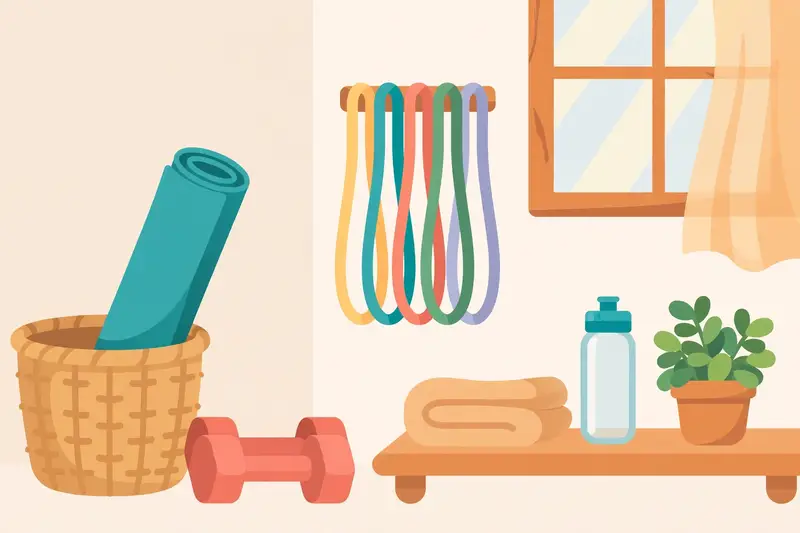
I still remember the day I decided I was done paying for a gym membership I barely used. I was standing in my kitchen, looking at the calendar, and doing the math in my head. The monthly fee, the driving time, the locker room, the waiting for machines — it added up to a lot of money and a lot of excuses. I did not need a fancy facility. I needed a corner of my own home, a few good pieces of equipment, and a routine I could actually stick with.
If that sounds familiar, you are in the right place. Building a home gym does not have to mean spending thousands of dollars or turning a whole room into a fitness studio. It can start with a mat, a pair of dumbbells, and a set of resistance bands, all tucked into a closet or slid under a bed. Over the years, I have helped many women in their forties, fifties, and sixties set up small home gyms, and the ones that last are almost always the simple ones.
This article will walk you through the whole process, step by step. We will talk about why a small home gym often works better than a big one, which three pieces of equipment are worth buying first, what you can skip, how to set up a tiny space, and how to shop smart so you stay on budget. I will also share a couple of sample workouts you can do with your new gear and a plan for growing your gym slowly over time, one piece at a time.
Why a Small Home Gym Beats a Big One
There is something powerful about a workout space that belongs to you. No commute, no waiting, no worrying about what anyone else thinks. You can work out in your oldest leggings, with your favorite music playing, at whatever hour suits your day. For many of us, that privacy is the difference between exercising three times a week and not exercising at all.
A small home gym also removes the most common excuse I hear: time. When your gym is ten steps from your bedroom, a twenty-minute workout is genuinely twenty minutes. You do not lose half an hour to driving and parking. On busy days, that matters more than any piece of equipment ever could.
Cost is the other big advantage. A gym membership can run forty to eighty dollars a month, which adds up to five hundred to nearly a thousand dollars a year. A starter home gym, by comparison, often costs less than three months of membership fees, and the equipment is yours to keep. You pay once, and you use it for years.
There is also the comfort factor. At home, you control the temperature, the music, and the pace. You can pause to drink water, stretch a little longer, or repeat an exercise until it feels right. Nobody is watching the clock on your machine. That relaxed feeling helps you focus on moving well instead of rushing through.
Finally, a small setup keeps things simple, and simple is sustainable. When you own three pieces of equipment, you learn to use them well. You are not overwhelmed by choices. You show up, you pick up your dumbbells, and you move. That consistency, repeated week after week, is what builds real strength and energy over time.
The First Three Pieces Worth Buying
If you buy nothing else, buy these three things: a pair of dumbbells, a set of resistance bands, and a good exercise mat. Together, they cover strength training, mobility, stretching, and floor work. They also fit in a small basket or a closet shelf, which makes them perfect for apartments and small homes.
A Pair of Dumbbells
Dumbbells are the workhorse of any home gym. You can use them for squats, rows, presses, lunges, and dozens of other movements. They help you build strength gradually, and they make everyday tasks — carrying groceries, lifting a suitcase, gardening — feel easier.
For most women starting out, a pair of light dumbbells in the three to eight pound range is a good place to begin. If you already have some strength, you might start with eight to twelve pounds. Adjustable dumbbells, which let you change the weight with a dial or a pin, usually cost between seventy-five and two hundred dollars for a pair, while a simple fixed pair often runs twenty to fifty dollars depending on the weight.
When you are ready for a structured routine, a beginner dumbbell workout at home for women is a wonderful way to learn the basic moves with confidence. Start light, focus on your form, and add weight only when the exercises start to feel easy.
A Set of Resistance Bands
Resistance bands are my favorite budget buy, because they give you so much for so little money. A full set of loop bands or tube bands with handles usually costs fifteen to forty dollars, and a single band can cost as little as five to ten dollars. They weigh almost nothing, they travel well, and they are gentle on joints while still giving your muscles a real challenge.
Bands are especially useful for the muscles that dumbbells sometimes miss, like the small muscles around your hips and shoulders. They are also great for warming up and for stretching at the end of a workout. I keep a light band near my desk for quick shoulder rolls and hip openers during the day.
If you want ideas for using them, a resistance band workout for women over 40 shows how to build a full session around bands alone. You do not need heavy weights to feel your muscles working, and bands prove that beautifully.
A Good Exercise Mat
A mat might sound boring next to dumbbells and bands, but it is the piece you will touch every single workout. A decent exercise mat, usually twenty to fifty dollars, cushions your knees during floor work, keeps you from slipping during stretches, and marks out your workout space — even if that space is just a corner of the living room.
Look for a mat that is at least a quarter inch thick, with a surface that grips rather than slides. Longer mats are worth it if you are tall or like to stretch out fully. Roll it up and lean it against the wall when you are done, and your gym disappears in ten seconds.
Your mat is also where your cool-down happens. Gentle stretching on a comfortable surface at the end of a session is one of the nicest parts of working out at home, and a good mat makes you look forward to it instead of dreading the hard floor.
What to Skip (for Now)
One of the best ways to stay on budget is knowing what not to buy yet. The fitness world is full of shiny equipment that looks essential in a photo and gathers dust in real life. You can always add pieces later, once you know how you actually like to move.
Big cardio machines are the classic example. A treadmill or elliptical can cost anywhere from five hundred to well over two thousand dollars, and it takes up a large piece of floor. Walking outside, dancing in your living room, or marching in place during a workout can give you the same heart-pumping benefits without the price tag or the footprint. If you later decide you truly want a machine, you will buy it with confidence, knowing it fits your routine.
Specialty gadgets deserve the same pause. Ab wheels, balance boards, weighted vests, and fancy rollers all have their place, but none of them is necessary for a strong foundation. A fat-burning home workout for women can be done with bodyweight and your basic gear, no gadgets required. Save the extras for birthdays and holidays, when you can try one new thing at a time.
Matching sets and premium brands are another easy skip. Your dumbbells do not need to match your bands, and your mat does not need a famous logo. What matters is that the equipment is safe, sturdy, and comfortable to use. A plain, well-made piece that you use three times a week beats a beautiful set that sits in the corner.
Finally, skip the all-in-one home gym stations until you know your habits. These large systems can cost one thousand dollars or more, and they only make sense if you already work out regularly and know exactly which exercises you love. Start small, learn what you enjoy, and let your gym grow with you.
Setting Up a Small Space
You do not need a spare room. Most women I work with use a space about six feet by six feet — roughly the size of a yoga mat with room to step forward, backward, and to each side. A corner of a bedroom, a spot in the living room, or even a cleared area in the garage can work perfectly.
Start by clearing the floor and checking the basics. Is the surface flat and not slippery? Is there enough light? Can you open your arms wide without knocking anything over? A quick test is to stand in the middle of your space and reach up, then out to both sides. If you can do that comfortably, you have enough room.
Storage matters more than square footage. A small basket, a shelf, or a couple of hooks on the wall keeps your gear tidy and visible. When your equipment is easy to see and easy to grab, you are far more likely to use it. When it is buried behind boxes in a closet, you are not. I keep my bands hanging on a hook by the door and my dumbbells on the floor beside my mat, so setting up takes less than a minute.
A mirror is a nice touch if you have one, even a small one leaning against the wall. Watching your form helps you catch a rounded back or a knee drifting inward, and good form keeps you safe. If a mirror does not fit your space or your style, no problem — moving slowly and paying attention to how each exercise feels works just as well.
Think about the little comforts too. A water bottle, a small towel, and a speaker or phone stand make the space feel welcoming. Some women like a small plant or a favorite photo nearby. These touches sound trivial, but they turn a corner of a room into a place you actually want to spend time in.
If you share your home with family or roommates, a simple agreement helps. Pick your usual workout times and let everyone know that is your time. Even twenty minutes of uninterrupted movement is easier when the people around you know the plan and respect it.
Budget-Friendly Shopping Tips
You can build a lovely home gym for somewhere between one hundred and three hundred dollars if you shop patiently. The trick is to buy the basics first, compare prices calmly, and resist the urge to buy everything at once. Here are the habits that have saved me the most money over the years.
First, make a short list and stick to it. Write down the three starter pieces, your budget for each, and nothing else. A list keeps you focused when a sale tempts you toward something you do not need yet. It also gives you a clear sense of when your starter gym is complete, which feels wonderful.
Second, compare a few options before you buy. Prices for the same dumbbell or mat can vary by twenty dollars or more from one seller to another, and a few minutes of comparing can save enough for your next piece of equipment. Read the reviews too, especially the ones that mention durability and grip, because a cheap piece that breaks in a month is no bargain at all.
Third, consider secondhand gear. Dumbbells, kettlebells, and mats are sturdy items that hold up well, and many people sell barely used equipment when they move or change routines. Check local listings and community groups, and inspect anything you buy for cracks, rust, or worn handles before you pay. A used pair of dumbbells that costs half the new price is a genuine win.
Fourth, watch for seasonal sales, but do not wait forever. Holiday weekends and the start of the year often bring discounts on fitness gear, and it is sensible to time a bigger purchase around one. Still, do not let waiting become another excuse. A mat bought today and used three times this week is worth more than a perfect bargain you never get around to buying.
Fifth, buy one weight before you buy five. Many women start with one pair of dumbbells, use them for a month, and then know exactly what weight they need next. Buying a full rack on day one often means owning weights you never touch. Let your body tell you what to buy next.
Finally, remember that your time and energy are part of the budget too. The cheapest gym in the world is useless if setting it up feels like a chore. Spend a little of your budget on the comforts that make you show up — a mat you love, bands that feel good in your hands, a basket that keeps everything tidy. Those small pleasures pay for themselves many times over.
Sample Workouts With Your New Gear
Once your starter gym is ready, you do not need a complicated plan. Two simple sessions a week, plus some walking, is a wonderful beginning. Keep each session to twenty or thirty minutes, rest between exercises, and move at a pace that lets you breathe comfortably and keep good form.
Warm up for about five minutes before each workout. March in place, roll your shoulders, swing your arms gently, and do a few slow squats without weight. A warm body moves better and feels better, and five minutes is a small price for a smoother session.
Workout A: Full Body With Dumbbells
Start with goblet squats, holding one dumbbell close to your chest. Do eight to ten slow repetitions, pushing through your heels and keeping your chest up. Rest for thirty seconds, then move to dumbbell rows: hinge forward slightly, pull one dumbbell toward your hip, and lower it with control. Eight to ten repetitions on each side is plenty.
Next, try an overhead press with both dumbbells, pressing up gently and lowering slowly for eight to ten repetitions. Follow that with a glute bridge on your mat, with or without a dumbbell resting on your hips, for ten to twelve repetitions. Finish with a standing calf raise, holding a dumbbell in each hand, for twelve to fifteen slow repetitions.
Repeat the whole circuit twice if you feel up to it, and stretch for five minutes at the end. If you would like a guided version of this style of training, a kettlebell workout at home for women offers another way to practice similar full-body movements once you add a kettlebell to your collection — a single kettlebell usually costs thirty to eighty dollars, depending on the weight.
Workout B: Bands and Bodyweight
Begin with banded side steps, placing a loop band just above your knees and taking ten slow steps to the right, then ten to the left. Then do band pull-aparts, holding a band at shoulder height and pulling it apart across your chest for twelve repetitions. These two moves wake up your hips and your upper back beautifully.
Next, try wall push-ups or knee push-ups on your mat for eight to ten repetitions, followed by a bird-dog on all fours — extending one arm and the opposite leg, holding for a few seconds, then switching sides. Finish with a seated band row, legs extended, pulling the band toward your waist for ten to twelve repetitions.
Move slowly, breathe steadily, and stop any exercise that causes sharp pain. A good workout should leave you feeling pleasantly tired, not beaten up. Over time, you can make these sessions harder by adding repetitions, using a heavier band, or slowing each movement down even further.
Growing Your Gym Over Time
One of the joys of a home gym is watching it grow with you. After a month or two of regular workouts, you will know exactly what you want next, because your body will tell you. Maybe your dumbbells feel light during squats, or you wish you had a heavier band for rows. That is the perfect moment to add one new piece.
A common next step is a heavier pair of dumbbells or a single kettlebell. Kettlebells are wonderfully versatile for swings, deadlifts, and carries, and one good kettlebell can add years of variety to your routine. Adjustable dumbbells are another smart upgrade, since one pair can replace a whole rack as you get stronger.
After that, many women add a stability ball, usually twenty to thirty-five dollars, which is lovely for core work and gentle stretching. A foam roller, often fifteen to thirty dollars, is another favorite for easing tight muscles after a workout. A sturdy step platform, around thirty to sixty dollars, opens up step-ups and incline push-ups. Each of these is a small, useful addition, and none of them demands a big budget.
The key is to add one piece at a time and use it for at least a few weeks before buying anything else. This slow pace keeps your spending under control, keeps your space uncluttered, and lets you truly learn each new tool. A home gym built slowly, piece by piece, fits your life far better than one bought in a single shopping spree.
It also helps to revisit your space every few months. Is everything still easy to reach? Is anything gathering dust? If a piece no longer earns its place, pass it along to a friend or sell it and use the money toward something you will actually use. A small gym stays inviting when everything in it has a purpose.
Keeping It Going Week After Week
The best home gym in the world only works if you use it, so it is worth thinking about what keeps you showing up. For most of us, the answer is not willpower. It is routine, enjoyment, and a little bit of kindness toward ourselves on the hard days.
Start by anchoring your workouts to something you already do. Maybe you exercise right after your morning coffee, or right before your evening shower. Linking a new habit to an old one makes it far easier to remember, and after a few weeks it starts to feel automatic. If mornings are not your thing, try lunch or early evening instead. The best time to work out is the time you will actually do it.
Track your progress in a simple way. A notebook on the shelf, a note on your phone, or a tick on the calendar is enough. Write down what you did, how it felt, and any small win — one more repetition, a slightly heavier dumbbell, a stretch that felt easier. Those small wins add up, and looking back at them on a low-motivation day can be surprisingly encouraging.
It also helps to keep your sessions short on busy days. A ten-minute workout still counts. Ten minutes of movement beats zero minutes every single time, and short sessions keep the habit alive when life gets hectic. You can always do more on the days when you have energy to spare. If you would like support for building that steady rhythm, stay consistent with at-home workouts has practical ideas for keeping your routine going through busy seasons and slow weeks alike.
Finally, be patient with yourself. Strength builds slowly, and that is normal. The goal is not to transform overnight. The goal is to feel a little stronger, a little steadier, and a little more energetic than you did last month. Your home gym is simply the friendly little space where that happens, one workout at a time.
A Quick Recap Before You Shop
Let us pull it all together. Start with three pieces: dumbbells, resistance bands, and a mat. Expect to spend roughly one hundred to three hundred dollars for a solid starter set, depending on the weights and quality you choose. Skip the big machines and specialty gadgets until you know your routine, and set up a small, tidy corner where your gear is visible and easy to reach.
Shop with a list, compare prices, consider secondhand finds, and add one piece at a time as you grow stronger. Use your gear two or three times a week with simple, full-body sessions, and keep a short cool-down and stretch at the end of each workout. Before starting any new exercise routine, especially if you have a health condition, an old injury, or you have been inactive for a while, check with your doctor first. A quick conversation with a health professional can help you choose the safest starting point for your body.
Your home gym does not need to impress anyone. It needs to welcome you, morning after morning, with a mat rolled out and dumbbells waiting by the door. Build it slowly, use it kindly, and let it grow with you. I am cheering you on from my own little corner gym, and I hope yours brings you the same steady strength and quiet confidence mine has brought me.
This article is general information only and is not medical advice. It is not a substitute for professional help. If you have a health condition or any concerns about starting a new exercise routine, please talk with your doctor or another qualified health professional first.