There is a moment most of us know well. You reach for something on a high shelf, or you twist to grab a bag from the back seat of the car, and something in the middle of your body feels less steady than it used to. It is not pain, exactly. It is more like a small wobble, a reminder that the center of you is doing a job you never really thought about before. I know that moment because I have had it myself, more than once, and it is one of the reasons I started taking core training seriously in my fifties.
For a long time, I thought core work meant sit-ups. I pictured endless crunches on a mat, the kind that left my neck sore and my lower back complaining. I avoided them, and honestly, I avoided core work altogether. It felt boring, it felt hard in the wrong places, and it never seemed to connect with the rest of my life. What I have learned since then is that real core training is nothing like that. It is practical, it is gentle when it needs to be, and it supports almost everything else you do, from carrying groceries to getting up off the floor with your grandkids.
This article is a simple, at-home core workout built for women over forty. It takes about fifteen minutes, it needs no equipment, and every move comes with a modification so you can start where you are today. You do not need a gym membership, a special mat, or any experience. You just need a little floor space and a willingness to move slowly and pay attention to how your body feels.
Before we get into the routine, let me say the most important thing first. If you have a health condition, a recent injury, or any concern about starting a new exercise routine, please check with your doctor first. This workout is general information, not a prescription, and your doctor knows your history better than any article ever could. If a move causes sharp pain, stop. Discomfort from effort is one thing; pain is a signal, and it deserves respect.
Why Core Strength Matters More After 40
After forty, our bodies change in ways that are completely normal and completely worth paying attention to. Muscle mass declines a little each year if we do nothing about it. Hormonal shifts during perimenopause and menopause change where we carry weight and how our joints feel. Our balance becomes a little less automatic. None of this is a crisis, but all of it is a reason to train the center of the body on purpose.
Your core is what keeps you upright when you walk across an icy parking lot. It is what steadies you when you lift a suitcase into an overhead bin. It is what helps you stand up from a low chair without grabbing the armrests. When the core is weak, other parts of the body try to compensate. The lower back takes on work it was never meant to carry alone. The hips tighten up. The shoulders round forward. A little regular core work can ease some of that everyday strain, and it often makes other kinds of exercise feel easier too.
There is another reason I love core work at this stage of life, and it is confidence. Strength in the middle of your body changes how you carry yourself. You stand taller without thinking about it. You move with a little more ease. You trust your body a little more. That is not vanity. That is the quiet benefit of knowing your body can still do hard things, and that you are the one teaching it.
If you already do some strength training for women over 40, core work fits naturally alongside it. The two support each other. Strong legs and arms are wonderful, but they work best when the trunk connecting them is stable. Think of it this way: your arms and legs are the limbs of a tree, and your core is the trunk. A strong trunk lets the branches move freely.
What the Core Really Is (It Is Not Just Your Abs)
When most of us hear the word core, we picture the six-pack muscles across the front of the stomach. Those muscles, the rectus abdominis, are part of the core, but they are only one piece of a much bigger system. The real core is a cylinder of muscles that wraps all the way around your middle, from your ribs down to your pelvis, and from your belly button around to your lower back.
On the front you have the rectus abdominis and the transverse abdominis, a deep muscle that acts like a natural corset. On the sides you have the obliques, which help you twist and bend. In the back you have the muscles along the spine that keep you upright. Underneath, the pelvic floor supports your organs and works with the diaphragm, the breathing muscle at the bottom of your rib cage. When all of these muscles work together, your trunk is stable and your movements are smooth.
That is why good core training is not about doing a hundred sit-ups. It is about teaching all of those muscles to work as a team. Some of the best core exercises barely look like exercise at all. You are lying on your back, moving one arm and one leg, breathing steadily, and keeping your lower back quiet. It looks easy. It is not, and that is the point. The work is in the control, not in the drama.
Understanding this changes how you approach the workout. You are not chasing a burn or a visible result. You are building a skill: the skill of holding your trunk steady while your arms and legs move. That skill shows up everywhere, from the way you carry a laundry basket to the way you get out of bed in the morning.
What You Need Before You Start
You need very little. A mat or a folded blanket on the floor is enough. A folded towel can support your head during the lying-down moves. Wear comfortable clothes you can move in, and go barefoot or wear socks with grip if your floor is slippery. Keep a glass of water nearby, and pick a spot where you have room to stretch your arms and legs out fully in every direction.
Give yourself fifteen minutes without interruption if you can. Put your phone on silent. Let the family know you are taking a few minutes for yourself. This is not a long workout, and part of its value is that it asks you to slow down and focus. You are not racing the clock. You are practicing moving well.
Warm up for about two minutes before the routine. Walk around the room, roll your shoulders a few times, and do a few gentle marching steps in place. A short stretching routine for women over 40 afterward, or even a few minutes of easy stretching before you begin, can help your joints feel ready. You want your body warm and your breathing settled before you lie down on the mat.
The 15-Minute Core Routine
This routine has six moves. Do them in order, resting for about thirty seconds between moves. The whole thing takes about fifteen minutes, including the rest. Move slowly, breathe steadily, and focus on quality over quantity. If a move feels too hard, use the modification. If a move feels too easy, slow it down even more, because slow is often harder than fast.
1. Dead Bug (8 reps per side)
Lie on your back with your knees bent and lifted so your hips and knees are both at about ninety degrees. Reach your arms straight up toward the ceiling. Press your lower back gently into the floor. This is your starting position, and keeping that gentle contact with the floor is the whole exercise.
Slowly extend your right arm back overhead and your left leg out straight, hovering just above the floor. Exhale as you extend. Bring them back to the start, then switch sides. Keep your lower back pressed down the entire time. If your back starts to arch, you have gone too far, so shorten the reach.
Modification: keep your arms still and just move one leg at a time, or bend the extending leg slightly instead of straightening it fully. This is still a real core exercise. The goal is control, not a long lever.
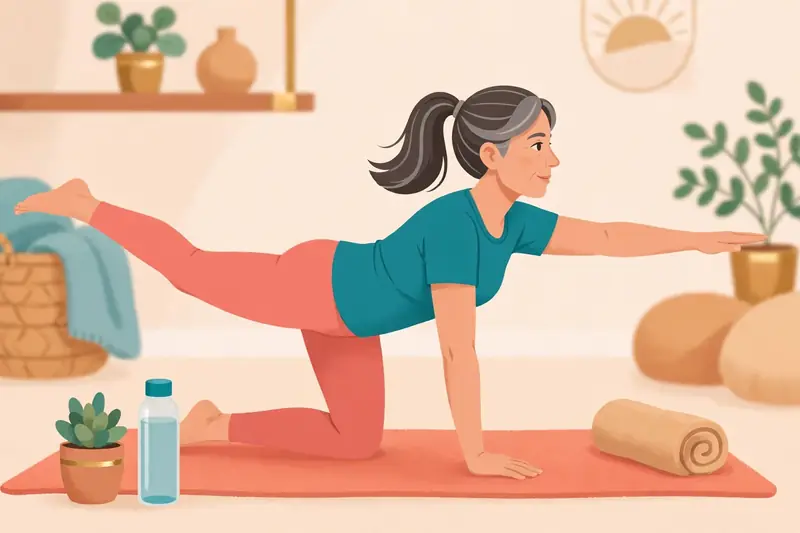
2. Bird Dog (8 reps per side)
Start on your hands and knees, with your hands under your shoulders and your knees under your hips. Keep your neck long and your gaze down at the floor. Imagine a glass of water balanced on your lower back, and try not to spill it.
Slowly reach your right arm forward and your left leg back, making one long line from your fingertips to your heel. Hold for two or three seconds, breathing normally. Bring them back, then switch sides. Keep your hips level. If you wobble, that is fine. The wobble is your core learning.
Modification: lift only the arm, or only the leg, until your balance feels steadier. You can also keep your toes lightly touching the floor behind you instead of lifting the leg fully. Over time, the full version will feel more natural.
3. Glute Bridge (12 reps)
Lie on your back with your knees bent and your feet flat on the floor, about hip-width apart and close enough that your fingertips can almost touch your heels. Your arms rest at your sides, palms down. Press through your heels and lift your hips toward the ceiling until your body forms a straight line from your shoulders to your knees.
Squeeze your glutes at the top and hold for two seconds. Lower down slowly, one vertebra at a time, like you are unrolling your spine onto the mat. Do not let your hips drop quickly. The slow lowering is half the exercise.
Modification: lift only halfway, or place a folded towel under your head for comfort. If your hamstrings cramp, move your feet a little farther from your body. This move strengthens the back of the body, which is an important part of the core system.
4. Side Plank (20 to 30 seconds per side)
Lie on your right side with your legs stacked. Prop yourself up on your right forearm, with your elbow directly under your shoulder. Lift your hips so your body forms a straight line from your head to your feet. Keep your top hand on your hip or reach it toward the ceiling.
Breathe steadily and keep your hips from sagging or hiking up. Hold for twenty to thirty seconds, then lower down with control and switch sides. If one side feels weaker than the other, that is normal. Most of us have a stronger side and a weaker side, and training both helps even things out.
Modification: bend your knees and rest on your lower knee instead of your feet, which shortens the lever and makes the hold much more manageable. You can also do this move against a wall or a sturdy countertop, leaning at an angle, which is a good place to start.
5. Forearm Plank (20 to 30 seconds)
Come onto your forearms and your toes, with your elbows under your shoulders and your body in one long line from head to heels. Press the floor away with your forearms. Keep your neck long and your gaze down. Squeeze your glutes gently and draw your belly button in slightly, without holding your breath.
Hold for twenty to thirty seconds, breathing the whole time. If your hips start to sag or rise, reset. A shorter plank with good form is worth far more than a long plank with a sagging back. When the time is up, lower your knees to the floor with control.
Modification: drop to your knees, which keeps the same long line from knees to head and is a perfectly good plank. You can also do a plank with your hands on a sturdy chair or countertop, which reduces the load on your wrists and shoulders.
6. Standing Pallof Press (8 reps per side)
This last move is done standing, and it teaches your core to resist twisting, which is something you do all day without noticing. Stand sideways to a sturdy door handle or a banister and hold it with both hands at chest height, or simply clasp your hands together in front of your chest if you have nothing to hold.
Press your hands straight out in front of you, keeping your hips and shoulders facing forward. The challenge is to keep your body still while your arms extend. Hold for two seconds, then pull your hands back to your chest. Repeat, then turn around and do the other side.
Modification: keep your hands close to your chest and just practice the bracing, or do the move seated in a sturdy chair. The point is the resistance to rotation, not the equipment. Your own body provides plenty of challenge.
How to Breathe During Core Work
Breathing is part of the workout, not an afterthought. Many of us hold our breath when we work hard, and that makes everything tenser and less effective. For most of these moves, the pattern is simple: exhale on the effort, inhale on the return. Exhale as you extend an arm and leg in the dead bug. Exhale as you lift your hips in the glute bridge. Inhale as you come back to the start.
For the holds, like the plank and the side plank, keep breathing in a slow, steady rhythm. You should be able to talk in short sentences while you hold. If you cannot, you are probably working too hard or holding too long, and it is time to rest. There is no prize for turning blue.
Your diaphragm is a core muscle, and it works best when you breathe fully. Try this before your next session: place one hand on your belly and one on your chest, and breathe in through your nose so your belly hand rises a little. Breathe out slowly through your mouth. That deep, easy breath is the foundation of everything in this routine. A few minutes of easy yoga at home for women over 40 can also teach this kind of breathing, and it pairs beautifully with core work.
How Often Should You Do This?
Two or three times a week is a good target for most of us. Your core muscles need a day of rest between sessions, just like any other muscle group. You could do this routine on Monday, Wednesday, and Friday, or on whatever days fit your life. The exact days matter far less than the consistency.
On the other days, keep moving in other ways. Walk, stretch, garden, dance in your kitchen, or do a low-impact workout at home for women over 40. Your core is involved in all of these activities, and every bit of movement counts. You do not need to train your core every day to see it get stronger. In fact, resting between sessions is when your body rebuilds and adapts.
If you are just starting out, begin with twice a week and one round of the routine. After two or three weeks, when the moves feel more familiar, add a second round or a third day. Progress in core training is often quiet. One week you wobble in the bird dog, and a few weeks later you hold it steady without thinking. That is progress, even if no one else can see it.
Common Mistakes to Avoid
The first mistake is going too fast. When we rush through core exercises, momentum does the work instead of our muscles. Slow down. Count to three on the way out and three on the way back. You will feel the difference immediately, and your lower back will thank you.
The second mistake is pulling on your neck. If you do any crunch-style movement, keep your hands light behind your head and lift from your chest, not from your chin. Better yet, stick with the moves in this routine, which keep your neck out of the equation almost entirely.
The third mistake is letting your lower back arch or sag. In the plank, the dead bug, and the bird dog, your lower back should stay neutral, not arched like a hammock and not rounded like a scared cat. If you cannot hold the position without your back moving, shorten the move. A smaller range with a quiet back is always better than a big range with a wobbling spine.
The fourth mistake is holding your breath. We covered this above, but it is worth repeating, because almost everyone does it. If you catch yourself holding your breath, pause, take two easy breaths, and start again. You are not failing. You are learning.
The fifth mistake is doing only the moves you like and skipping the ones you find hard. The hard ones are usually the ones you need most. If the side plank is your nemesis, that is a clue, not a reason to skip it. Do the modified version, hold for a shorter time, and build up slowly. Your weaker side deserves the most patience.
The sixth mistake is expecting a visible change in your stomach and quitting when it does not appear. Core training is not a spot-reduction tool, and no exercise can target fat in one place. What core training does is build strength, stability, and confidence, and those show up in how you move and how you feel long before they show up in a mirror.
What About Crunches and Sit-Ups?
You might be wondering why this routine has no crunches or sit-ups. There is a reason. For many women over forty, repeated sit-ups put a lot of pressure on the lower back and the neck, and they train only one small part of the core while ignoring the rest. You can absolutely include a few gentle curl-ups if you enjoy them, but they are not necessary, and they are not the best place to start.
The moves in this routine train the core the way you actually use it: holding steady while your limbs move, resisting twist, and supporting your spine. That is called functional training, and it is the kind that carries over into real life. If you love crunches, you can add a few at the end of your session. Just keep them slow, keep your neck relaxed, and stop if your back complains.
Many of the gentle, controlled movements in Pilates at home for women beginners work the same deep core muscles, and they are a lovely complement to this routine. If you enjoy the slow, precise feeling of this workout, Pilates will probably feel like a natural next step.
Making Core Work a Habit That Sticks
The best routine in the world is useless if you never do it, so let us talk about how to actually keep this going. The first rule is to make it small. Fifteen minutes is already small, but on a busy day, even five minutes counts. Do two moves instead of six. Do one round instead of two. A short session you actually do is worth more than a perfect session you keep postponing.
The second rule is to attach it to something you already do. Do your core work right after your morning coffee, or right after your evening walk, or while the kettle boils. When a new habit rides along with an old one, it is much easier to remember. I do mine after my morning stretch, in the same spot, with the same mat. The routine of the routine is half the battle.
The third rule is to track it simply. Put a check mark on a calendar every time you finish. After a few weeks, you will have a row of check marks that feels good to look at, and you will not want to break the chain. Do not track how you looked or what you weighed. Track the fact that you showed up. That is the number that matters.
The fourth rule is to be kind to yourself on the days you miss. You will miss days. Life happens, kids visit, work runs long, you get sick, the dog needs the vet. Missing a day is not failure. It is a normal week. Just do the next session when you can, without guilt and without trying to punish yourself with a double workout. Consistency over months beats intensity over days, every single time.
The fifth rule is to notice the small wins. Maybe you can hold the plank ten seconds longer than last month. Maybe you can get up from the floor without using your hands. Maybe your back feels less tired at the end of a long day of standing. Write those wins down. They are real, and they are the reason to keep going.
A Sample Week With Core Work Included
Here is one way a week could look, just as an example. On Monday, do this core routine after a short walk. On Tuesday, take a longer walk or do some gentle stretching. On Wednesday, repeat the core routine, perhaps adding a second round of the moves that feel easiest. On Thursday, rest or take an easy walk. On Friday, do the core routine a third time, and finish with a few minutes of stretching.
Over the weekend, do something you enjoy. Garden, swim, hike, dance, or play with your grandkids at the park. All of that counts as movement, and your core is working during every bit of it. You do not need to schedule your whole life around exercise. You need a few regular sessions and a generally active life, and the two support each other.
If you want to build more strength over time, you can gradually increase the holds in the plank and side plank by five seconds every week or two, or add one more rep to each move. Small increases, made slowly, are the safest way to get stronger. Your body adapts to what you ask of it, as long as you ask gently and consistently.
When to Ask for Extra Help
Most of us can do this routine safely on our own, but there are times when extra guidance is worth it. If you have had abdominal surgery, if you have a hernia, if you have pelvic floor concerns, or if you have ongoing back pain, a physical therapist or a qualified fitness professional can help you adapt these moves to your body. That is not a sign of weakness. It is a smart use of expertise.
Similarly, if you are recovering from an injury or managing a condition like osteoporosis, ask your doctor or therapist which moves are right for you and which to skip. There is almost always a version of core training that works for your situation, but finding it is easier with someone who can watch you move and give you feedback.
Pay attention to your pelvic floor during this work, too. If you notice leaking when you exert yourself, that is common and it is worth mentioning to your doctor. It is not something to be embarrassed about, and it is not something you have to accept as inevitable. There are professionals who specialize in exactly this, and a short conversation can make a real difference.
Your Core Is Worth Fifteen Minutes
I will be honest with you. Core work is not glamorous. There is no beautiful scenery, no music, no applause. It is you, on a mat, moving slowly and breathing on purpose. Some days it will feel meditative. Some days it will feel tedious. Do it anyway, because the payoff is in the ordinary moments of your life.
The payoff is carrying a bag of groceries without thinking about your back. It is stepping off a curb with confidence. It is getting down on the floor to play with a grandchild and getting back up again without a production. It is standing tall in a photograph and liking what you see, not because of how you look, but because of how you feel in your own body.
You are not too old for this. You are not too out of shape for this. You are not too late. Fifteen minutes, two or three times a week, with moves you can modify and a pace you control, is a genuinely good place to start. Your core has been supporting you your whole life, mostly without thanks. This is a small way to return the favor.
Roll out your mat, set a timer for fifteen minutes, and begin with the dead bug. Go slowly. Breathe. Notice what your body can do today, and trust that it can do a little more next week. That is how strength is built at any age, one quiet session at a time.
This article is general information only and is not medical advice. It is not a substitute for professional medical advice, diagnosis, or treatment. Please check with your doctor before starting any new exercise routine, especially if you have a health condition, a recent injury, or any concerns about your health.