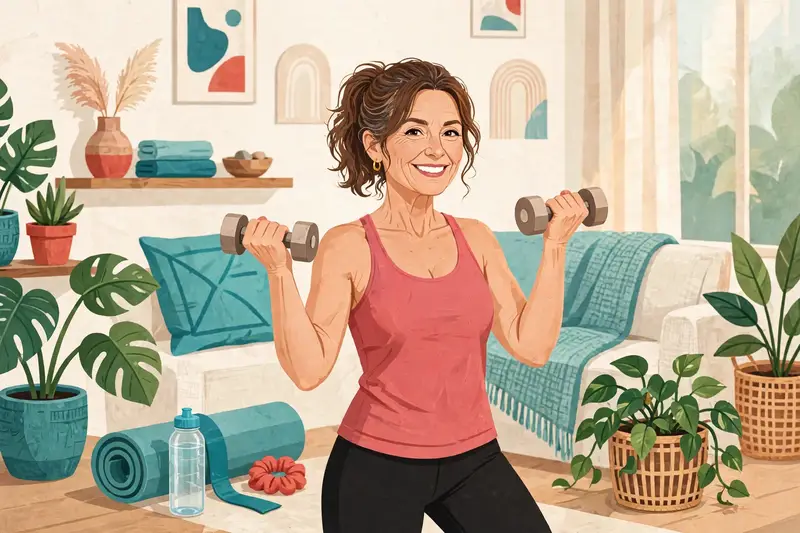
I want to tell you something I wish someone had told me at forty, when I first noticed that the things that used to be easy were getting a little harder. The jar that used to open without a thought. The suitcase that used to feel light. The stairs that used to be nothing. None of it happened all at once, and none of it was dramatic. It was slow and quiet, and for a while I told myself it was just age, and there was nothing to be done about it. That last part was wrong. There was something to be done about it, and it was the simplest thing in the world: I started building muscle, at home, with a pair of dumbbells and a plan.
Building muscle after forty is not about getting big, and it is not about looking like someone in a fitness magazine. It is about keeping the strength you need to live your life on your terms: carrying your own groceries, getting up off the floor without a second thought, walking up the stairs without holding the rail, and knowing your body can do what you ask of it. Muscle is what makes all of that possible, and the good news, the genuinely hopeful news, is that your body can still build it. Women in their forties, fifties, and sixties build muscle when they train for it, sometimes faster than they expect, because their bodies have been waiting for the signal.
This is my guide to building muscle after forty: how muscle is actually built, the simple plan I follow at home, what to eat, how much to rest, and how to know it is working. No gym required, no experience needed, and no promises about what your body will look like in thirty days. Just the honest mechanics, a plan you can start this week, and the reasons I believe this is one of the most hopeful things a woman over forty can do.
How Muscle Is Actually Built
Muscle is built by a simple cycle, and understanding it will make everything else in this article make sense. When you lift something heavy enough to challenge your muscles, you create tiny amounts of stress in the muscle fibers. Your body responds to that stress by repairing the fibers, and it repairs them a little stronger than they were before, so they can handle the same challenge more easily next time. That repair is where muscle is built, and it happens mostly while you rest and sleep, not while you are lifting.
This is why the three parts of the cycle all matter, and why you cannot skip one of them. The training sends the signal. The food, especially protein, gives your body the material to rebuild. And the rest gives it the time. If you train hard but eat almost no protein, the rebuilding is limited. If you eat well but never challenge your muscles, there is no signal to respond to. And if you train every single day without rest, your body never gets the quiet time it needs to do the repair. The women who build muscle are not the ones who train the hardest. They are the ones who respect all three parts of the cycle.
There is one more idea that matters, and it has an awkward name: progressive overload. It just means that to keep building muscle, you have to ask a little more of your muscles over time. A little more weight, a few more repetitions, one more set, or a slower, more controlled movement. The increases should be small, a pound or two, or two extra repetitions, because small increases are the ones your body can actually adapt to. I write about the beginner side of this in my strength training for women over 40 article, and the message is the same: start light, add a little at a time, and let your body catch up.
The Five Patterns (With a Muscle-Building Focus)
You do not need a dozen exercises. You need five movement patterns, and you need to do them regularly, with enough challenge to send the signal. The patterns are the same ones I use in every workout: the squat, the hinge, the push, the pull, and the carry. What changes when your goal is building muscle is how you do them: more attention to form, a slower pace, and a focus on the muscles you are trying to train rather than on finishing as fast as you can.
The squat trains your legs and glutes, the biggest muscles you have, and it is the pattern that gives you the most return for your effort. A goblet squat, holding one dumbbell at your chest, is my favorite version for home, because it teaches good form naturally: you cannot lean too far forward without losing your balance, so your body finds the right position on its own. The hinge trains your hamstrings, glutes, and lower back, the muscles that protect your spine. A Romanian deadlift with dumbbells is the version I use most, and the key is to push your hips back and keep the weights close to your legs, feeling the stretch in the backs of your thighs.
The push trains your chest, shoulders, and triceps. A dumbbell chest press on the floor is a safe, simple version, and a slow wall push-up works if you are starting from zero. The pull trains your back and biceps, the muscles that keep your posture tall and your shoulders healthy. A one-arm row, with one hand braced on a chair, is the version I recommend, because it lets you focus on one side at a time and use a weight that actually challenges you. And the carry trains your grip, your core, and your balance all at once: hold a dumbbell in each hand, stand tall, and walk down the hallway and back. It is the most practical exercise I know, because it is exactly what carrying groceries feels like.
If you want to see these patterns inside a real program, my post on LIIFT4 at home workout results shows what structured lifting looks like over weeks, and my guides and workbooks include starter routines you can print. But you do not need a program to begin. You need the five patterns, a pair of dumbbells, and a willingness to do them slowly and well.
Sets, Reps, and Rest (The Simple Version)
Here is the part that confuses most beginners, so let me make it as simple as I can. For building muscle, the range that works best for most women is three sets of eight to twelve repetitions of each exercise. A repetition is one full movement: one squat, one press, one row. A set is a group of repetitions done without stopping. Three sets of ten means you do ten squats, rest, do ten more, rest, and do ten more. That is the whole structure.
Rest for sixty to ninety seconds between sets. That is long enough for your muscles to recover a little, and short enough to keep the session moving. Rest for a full minute between exercises if you need it. A session built this way takes thirty to forty minutes, including the warm-up and the cool-down, and three sessions a week is enough to build muscle. You do not need five or six sessions. You need three good ones, with rest days in between, because rest is when the rebuilding happens.
Choosing the right weight is simpler than it sounds. Pick a weight that lets you finish your ten repetitions with good form, where the last two repetitions feel hard but doable. If you finish all ten and you could have done five more, the weight is too light. If you cannot finish eight with good form, it is too heavy. That is the whole test, and it is the one I use every time I pick up a new pair of dumbbells. When you can do all three sets of twelve repetitions and the last two still feel manageable, it is time to go a little heavier. A two-pound jump is a real jump, and you should be proud of it.
A Sample Week
Here is a week you can start on Monday, in your living room, with a pair of dumbbells and a mat. Day one is lower body: goblet squats, Romanian deadlifts, and glute bridges, three sets of ten each, with a farmer's carry to finish. Day two is rest, or a gentle walk. Day three is upper body: dumbbell chest presses, one-arm rows, and overhead presses, three sets of ten each. Day four is rest, or a gentle walk. Day five is full body: one squat, one hinge, one push, one pull, and a carry, three sets of ten each. The weekend is rest, or a long walk, or whatever your life needs.
Warm up before every session, for five minutes: march in place, roll your shoulders, do a few slow squats without weight, and let your body know what is coming. Cool down after, for five minutes: walk slowly, stretch the muscles you just worked, and breathe. The warm-up and the cool-down are not optional extras, especially after forty. They are the difference between feeling good tomorrow and feeling like you were hit by a truck.
Write it all down. A simple notebook, a page for each session, with the exercise, the weight, and the repetitions. That notebook is how you will know you are building muscle, because the numbers will climb. The squat that started at ten pounds will be fifteen, then twenty. The row that started at eight pounds will be twelve. Watching those numbers climb is one of the great quiet joys of this journey, and it is far more reliable than the mirror or the scale. I wrote about measuring progress this way in my post on measuring your weight loss progress by your new strength, and it is still the method I trust most.
Eating to Build Muscle
Training sends the signal, but food does the building, and protein is the material. After forty, your body needs a little more protein to get the same muscle-building benefit it got at thirty, which means protein at every meal is not a suggestion anymore. It is part of the program. I aim for a palm-sized portion at breakfast, lunch, and dinner: eggs in the morning, chicken or beans at lunch, fish or lentils at dinner. My own daily target is about 100 to 125 grams, worked out with my doctor, and your number may differ. A registered dietitian can help you find yours.
You do not need protein powders or special shakes, although a scoop in a smoothie is convenient on busy mornings. Real food works perfectly well, and it is what I mostly use. What matters is the pattern: protein at every meal, every day, not a huge amount once and then nothing for the rest of the day. And drink water steadily, because muscles are mostly water, and a dehydrated body does not recover well. If you want the full picture on eating for strength, my post on protein for women goes into the details, including how much most women need and where to find it.
One honest note: building muscle is not a weight-loss plan, and the scale may not move the way you expect. Muscle is denser than fat, which means your body can get smaller and stronger while the scale stays roughly the same, or even goes up a little. That is normal, and it is not a problem. Your clothes, your strength, and your energy will tell you the real story, and they are the measures I pay attention to.
Rest, Sleep, and Recovery
If training is the instruction and protein is the material, sleep is the construction crew. Muscle is repaired and built while you rest, mostly while you sleep, and a body that is short on sleep does not recover well no matter how good the training and the food are. I aim for eight hours, and I notice the difference in my strength when I get it. If your sleep is rough, start there before you add a fourth workout day. An extra hour of sleep will do more for your muscle than an extra session ever will.
Rest days are part of the program, not a break from it. Three training days and four rest days is the right balance for most women over forty, and the rest days are when the work you did in the gym, or in your living room, turns into actual muscle. Walking on rest days is fine, and gentle stretching is fine. Another hard workout is not. If you are tempted to train every day, remember that more is not always better. Better is better, and better means recovered.
And be patient with soreness. Some muscle soreness in the first week or two is normal, and it should fade within a couple of days and get milder each week. Pain in a joint, sharp pain, or pain that does not fade is different, and it is a sign to stop and check in with your doctor or a physical therapist. Soreness is your body learning. Pain is your body warning. Learning to tell them apart is part of the journey, and it is a skill worth developing.
Common Mistakes (and What to Do Instead)
The first mistake is lifting too light, forever. I see it all the time: a woman picks up the three-pound dumbbells, does her ten repetitions easily, and never picks up anything heavier, because heavier feels scary. But if the weight never challenges you, the signal never gets sent, and the muscle never gets the message. The fix is simple: when twelve repetitions feel easy, go up by two pounds. Two pounds is not scary. It is a small step, and small steps are how this works.
The second mistake is rushing. Fast, sloppy repetitions with momentum do far less for your muscles than slow, controlled ones. Lower the weight for three counts, pause for one, lift for two. Feel the muscle working. It will feel harder with less weight, and that is the point. The muscle does not know how much the dumbbell weighs. It knows how hard it has to work, and slow, controlled work is hard work.
The third mistake is skipping the lower body. Upper body work is more fun for most women, because you can see your arms changing in the mirror. But your legs and glutes are the biggest muscles you have, and training them gives you the most return for your effort. Strong legs are what keep you independent, and they are worth every squat. Do not skip leg day. Your future self, the one climbing stairs without thinking about it, will thank you.
My Honest Take on Getting Stronger After 40
Here is what nobody tells you about building muscle after forty: it is one of the most hopeful things you can do. Every other part of aging comes with a warning, but this one comes with a promise. You can be stronger next year than you are this year. Not a little stronger in theory, but measurably, noticeably stronger, in ways you can feel when you carry the groceries, climb the stairs, or get up off the floor without thinking about it. That is not a small thing. That is freedom, and it is available to you right now.
So here is my invitation. This week, pick three days, set aside thirty minutes, and do the five patterns. Start light, go slow, and write down what you did. Eat protein at every meal. Sleep as well as you can. Next week, do it again, a tiny bit heavier or a few more repetitions. That is the whole plan. No gym membership required, no special clothes, no audience. Just you, a pair of dumbbells, and a decision that your strength is worth thirty minutes of your day. If you want company on the journey, come find us in my free private community or my coaching group, where women are building muscle right alongside you, one small, steady step at a time.
This article shares general information and my own experience. It is not medical advice, and it is not a substitute for talking with your doctor, a registered dietitian, or another qualified professional about your own health, especially before you change how you eat or exercise. Every body is different, so please listen to yours and get personal guidance when you need it.