Let me be honest with you right from the start, because this is one of those topics where honesty matters more than motivation. You cannot pick one spot on your body and exercise the fat away from just that spot. I know that is not what the magazine covers promise, and I know it is not what most of us want to hear. But it is the truth, and I would rather give you the truth and a plan that actually works than sell you a fantasy and watch you get discouraged when your waistline does not shrink on schedule.
Here is what you can do, and it is plenty. You can strengthen the muscles of your core so your middle feels firmer and your posture improves. You can build a regular movement habit that supports your overall health and helps your body use energy more efficiently. You can eat and sleep and manage stress in ways that support your goals instead of working against them. And you can do all of that at home, with no equipment, in about twenty-five minutes. That is what this belly fat workout is: a simple, honest circuit that trains your whole body, with extra attention to your core, plus the daily habits that make the workout count.
I am not going to promise you a flat stomach in thirty days. What I will promise is this: if you do this circuit three times a week, walk daily, and pay a little attention to what you eat and how you sleep, you will feel stronger, stand taller, and move better. Your clothes may fit differently. Your energy may feel steadier. And you will have built something far more valuable than a quick fix: a routine you can keep.
Why Crunches Alone Never Worked
If crunches alone could shrink a waistline, every woman who ever did a hundred sit-ups a day would have the middle she wanted. But that is not how bodies work. Doing crunches strengthens the muscles underneath, and strong abdominal muscles are a good thing. They support your back, they help your posture, and they make everyday movements easier. But the muscles sit underneath a layer of body fat, and no amount of crunching targets that layer directly. Your body decides where to draw energy from, and it does not take requests.
That is why this workout is a full-body circuit, not a hundred crunches. Full-body movement burns more energy than isolating one muscle, and it builds muscle in your legs, your arms, and your back, which are the big muscles that do the heavy work. When you train the big muscles, your whole body gets stronger, and your core gets trained along the way, because almost every full-body move asks your core to stabilize you. The squat trains your core. The row trains your core. Walking up a hill trains your core. A strong middle is built by moving your whole body, not by lying on the floor doing crunches while the rest of you stays still.
This is also why the workout includes walking, and why I talk about food and sleep later in this article. Movement is the biggest piece, but it is not the only piece. I wrote about this in my post on measuring your weight loss progress by your new strength, and the idea is the same: the scale is only one measure, and often not the best one. How your clothes fit, how strong you feel, how well you sleep, and how steady your energy is will tell you more about your progress than a number ever will.
The 25-Minute Belly Fat Circuit
Here is the workout. You need a clear patch of floor, a sturdy chair, and a bottle of water. Warm up for five minutes first: march in place for two minutes, then do ten slow squats to a chair, ten shoulder rolls, and ten gentle torso twists, turning slowly from side to side with your arms relaxed. Your body should feel warm and loose before you start the circuit.
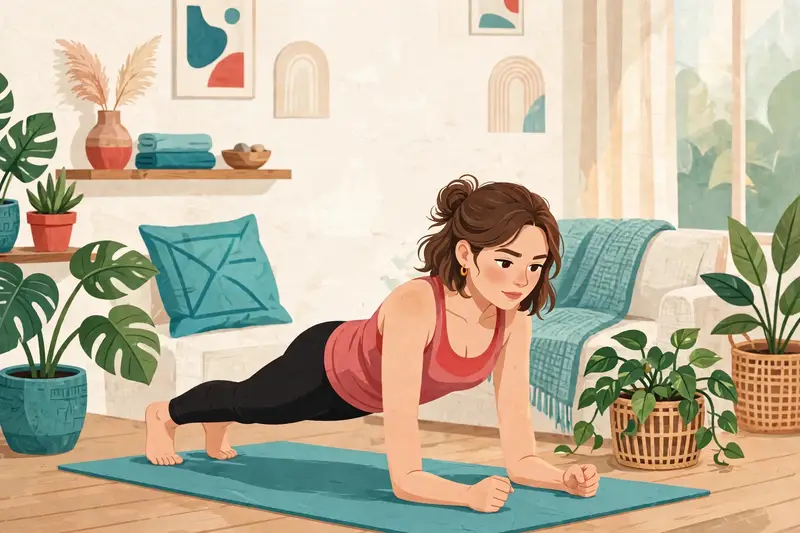
The circuit has six moves. Do each one for forty seconds, rest for twenty seconds, and move to the next. When you finish all six, rest for one minute, and then repeat the circuit two more times. The whole thing, warm-up included, takes about twenty-five minutes. The moves are: chair squats, knee push-ups or wall push-ups, glute bridges, step-backs into a small lunge, standing knee lifts (lift one knee toward your chest, alternate sides), and a plank on your knees or forearms. The plank is the only move that isolates your core, and even it trains your shoulders, your glutes, and your back at the same time.
Form matters more than speed. On the squats, push your hips back like you are sitting down, and keep your knees tracking over your toes. On the push-ups, keep your body in one straight line from head to knees, and lower yourself slowly. On the glute bridge, squeeze your glutes at the top and keep your ribs down. On the step-backs, take a small step and keep your front knee soft. On the knee lifts, stand tall and lift with control, not momentum. And on the plank, breathe. Holding your breath turns a good exercise into a miserable one, and it does not help your core work any harder.
Do this circuit three times a week, with a day of rest in between. On the other days, walk. Walking is the most underrated part of this whole plan, and I will tell you why in a moment. If the circuit feels too easy after a few weeks, make it harder by slowing down, not by speeding up. Slower squats, a longer hold at the top of the glute bridge, and a plank held for ten seconds longer will challenge your muscles far more than rushing through the moves ever will.
Walking: The Quiet Half of the Plan
If the circuit is the workout, walking is the habit that holds it together. I walk every day, and I am not talking about power walking in special shoes. I mean regular walking: around the block, through the grocery store, up the stairs instead of the elevator, around the house while I am on the phone. It adds up, and it adds up without beating up your joints or leaving you exhausted.
Walking works for this goal for a simple reason: it is movement you can do a lot of, every day, without needing to recover from it. A hard workout three times a week is wonderful, but it is only three hours of your week. Walking fills in the rest. Aim for a daily walk of twenty to thirty minutes, at a pace where you can talk but would rather not sing. If thirty minutes feels like a lot, start with ten. Ten minutes after lunch, ten minutes after dinner, and you are already at twenty. My post on how to fit exercise into your everyday life has more ideas for sneaking movement into a busy day, and every one of them counts.
One more thing about walking: it helps with stress, and stress matters more to your middle than most people realize. When you are stressed, your body holds on to tension, your sleep suffers, and your appetite gets louder, usually for exactly the foods that do not help. A walk, especially outside, is one of the simplest ways to let some of that pressure out. It is not a cure for a hard week, but it is a start, and starts are what we are collecting here.
What to Eat (Without a Diet)
I am not going to hand you a diet, because diets are not what this site is about. But I am going to tell you what has worked for me and for the women I coach, because food is half the story and pretending otherwise would be dishonest. The short version: eat protein at every meal, fill half your plate with vegetables, drink water before you reach for a snack, and keep the foods that trip you up out of easy reach. That is it. No counting, no cutting out entire food groups, no rules you will break by Wednesday.
Protein matters here because it helps you feel full, and it gives your body what it needs to keep the muscle you are building with the circuit. I aim for a palm-sized portion at breakfast, lunch, and dinner: eggs in the morning, chicken or beans at lunch, fish or lentils at dinner. My post on protein for women goes into the details, including how much most women need and where to find it. If you change one thing about how you eat, make it this: add protein to the meal where it is missing, usually breakfast.
Vegetables matter because they add volume to your meals without adding much energy, which means you can eat a satisfying plate and still feel good afterward. You do not need to love kale. You need a few vegetables you actually enjoy, cooked in a way you like, on your plate every day. And water matters because thirst often shows up disguised as hunger, and because a glass of water before a meal is the simplest appetite check there is. If you want a full week of meals that follows these ideas, my clean eating meal plan for beginners is a good place to start.
Sleep, Stress, and the Rest of It
Here is the part of the plan nobody wants to hear, because it is not a workout and it is not a recipe. Sleep. If you are sleeping five or six hours a night, your body is working against you, and no circuit can fully make up for it. Short sleep makes you hungrier, makes you crave richer foods, and makes it harder to recover from your workouts. I know this from experience, and I know it is the hardest part of the plan for busy women. But it is also the part with the biggest payoff.
I am not going to tell you to get eight perfect hours starting tonight. I am going to suggest one small change: pick a bedtime and protect the last thirty minutes before it. No scrolling, no news, no email. A book, a stretch, a cup of tea. That is all. Your sleep will not transform overnight, but it will improve, and better sleep makes everything else in this plan easier, including the mornings when you have to talk yourself into the circuit.
And be kind to yourself about the pace of change. Your body did not get where it is in a month, and it will not change in a month. The women who get discouraged are usually the ones checking the mirror every morning, looking for proof. Try checking once a month instead, and in between, pay attention to what is actually changing: the squats feel easier, the plank lasts longer, the stairs do not leave you breathless, your favorite jeans fit a little better. That is progress, and it is real, even when the scale has not moved. My post on when the scale does not go down and you are stuck in a plateau is the one I re-read myself when I need the reminder.
A Simple Week to Follow
Here is what a week of this plan looks like, so you can stop wondering and just start. Monday: the circuit. Tuesday: a thirty-minute walk. Wednesday: the circuit. Thursday: a thirty-minute walk. Friday: the circuit. Saturday: a longer walk, or a walk with a friend, or a walk somewhere pretty. Sunday: rest, or a gentle stretch. That is three circuits and four walks, and it fits into a normal life without taking it over.
After four weeks, look back. Not at the scale, but at your notes. Did the circuit get easier? Did you need fewer rests? Did you walk more days than you missed? If the answers are yes, you are doing it. Keep going. If you want a next step, add a fourth circuit day, or make the walks a little longer, or try my weight loss journey post for a fresh look at the habits that support the long run. The plan grows with you, one small step at a time.
My Honest Take on Belly Fat
I have spent years listening to women talk about their middles, and here is what I have learned: the women who make peace with the process are the ones who keep going, and the women who keep going are the ones who see change. Not because they found a secret, but because they stopped chasing one. They did the circuit, they walked, they ate a little better, they slept a little more, and they gave it time. Months, not weeks. That is the honest timeline, and I will not shorten it to make you feel better for a day.
So start this week. Clear a patch of floor, set a timer for twenty-five minutes, and do the circuit. Then walk tomorrow. Then do it again. Your core will get stronger, your posture will improve, and your body will change at its own pace, which is the only pace it has ever known. That is not a quick fix. It is something better: a routine that is actually yours, and a body that is getting stronger every week you keep it.
This article shares general information and my own experience. It is not medical advice, and it is not a substitute for talking with your doctor, a registered dietitian, or another qualified professional about your own health, especially before you change how you eat or exercise. Every body is different, so please listen to yours and get personal guidance when you need it.