I still remember the first time I noticed my balance was not quite what it used to be. I was reaching for a jar on the top shelf of my kitchen, standing on my toes, and I wobbled. It was nothing dramatic. I caught myself on the counter, laughed it off, and went on with my day. But that little wobble stayed in the back of my mind, because I realized that balance is one of those things we never think about until it starts to feel less steady.
If you have had a moment like that, you are not alone, and you are certainly not doing anything wrong. Balance changes as we age, just like eyesight and flexibility do. The good news is that balance is a skill, and like any skill, it can be practiced. You do not need special equipment, a gym membership, or an hour a day. You need a sturdy chair, a clear patch of floor, and a few minutes of patience with yourself.
In this article, I want to walk you through simple balance exercises that are made for women over 60. We will start gently, use support whenever we need it, and build a short daily routine you can actually stick with. My goal is not to turn you into a gymnast. It is to help you feel steadier on your feet, more confident walking into a room, and more at ease doing the everyday things you love.
Why Balance Changes as We Age
Balance is a team effort. Your eyes, your inner ear, the muscles in your legs and core, and the tiny sensors in your feet and ankles all send messages to your brain about where your body is in space. When you are younger, that system works quickly and quietly. As the years pass, each part of the system can slow down a little, and the messages do not arrive quite as fast.
Your leg muscles may not be as strong as they once were, especially if you spend much of the day sitting. The muscles around your ankles, which make the small corrections that keep you upright, can lose some of their responsiveness. Your eyesight may change, which matters more than most of us realize, because vision is one of the main ways your brain judges where you are. And the inner ear, which acts like a built-in level, can become less precise over time.
None of this means that losing your balance is inevitable. It means your balance system benefits from regular practice, just like your memory benefits from a good book or a crossword. When you practice standing on one foot or shifting your weight from side to side, you are giving your brain and your muscles a chance to work together again. You are reminding your body how to catch itself, correct itself, and stay upright.
There is another factor worth mentioning, and that is confidence. After one stumble or one close call, many of us start moving more carefully. We hold the railing a little tighter. We avoid uneven ground. We sit down to put on our shoes instead of standing. Those choices are sensible, but if we start avoiding movement altogether, our balance can get worse instead of better. Gentle, regular practice helps rebuild confidence alongside strength, and confidence is half the battle.
How Better Balance Protects Your Independence
When I talk about balance, I am not really talking about standing on one leg for a party trick. I am talking about the freedom to live your life the way you want to live it. Good balance is what lets you walk across a parking lot without worrying about every crack in the pavement. It is what lets you carry a basket of laundry up the stairs, step into the shower without hesitating, or walk the dog on a path that is not perfectly flat.
Think about the small moments that make up a day. Getting out of bed in the morning. Turning around in the kitchen to answer the phone. Reaching for a book on a shelf. Stepping off a curb. Each of these is a balance challenge, and each one is easier when your body knows how to adjust. When your balance is steady, you move through your day without having to think about every step, and that ease is a real gift.
Better balance also supports the other kinds of movement you enjoy. If you like to garden, dance, travel, or play with your grandchildren, balance is the quiet foundation underneath all of it. It helps you change direction smoothly, recover from a bump or a misstep, and keep going without fear. It also works hand in hand with strength. Strong legs help you catch yourself, and good balance helps you use that strength in the right moment.
Perhaps most importantly, working on your balance is an act of looking after yourself. It is a way of saying that your independence matters to you, and that you are willing to spend ten minutes a day protecting it. That is a kind and practical choice, and it is one you can start today, right where you are.
Before You Begin: A Few Safety Ground Rules
Before we get into the exercises, let us agree on a few ground rules. These are simple, but they matter, and I follow them myself every single time. First, always practice near support. Stand beside a sturdy chair, a kitchen counter, or a wall. Keep one hand lightly resting on the support, or keep it close enough to grab. You are not holding on because you are weak. You are holding on because smart exercisers plan for wobbles.
Second, wear flat, closed shoes with a good grip, or practice in bare feet on a non-slip surface if that feels safer to you. Avoid socks on a smooth floor, loose slippers, or high heels. Make sure the floor is clear of rugs that slide, cords, pet toys, and anything else you could trip over. A little tidying before you start is part of the exercise, in my book.
Third, go slowly and breathe normally. Balance exercises are not a race, and holding your breath will not help you stay upright. If an exercise feels too hard, make it easier. Stand closer to your support, keep both feet on the floor a little longer, or shorten the time you hold a position. There is no prize for pushing through dizziness or pain. If you feel dizzy, lightheaded, or unsteady in a way that worries you, sit down right away and rest.
Finally, if you have a health condition, take medication that affects your balance, or have been told by a doctor to be careful with exercise, please check with your doctor before starting a new routine. A quick conversation can help you understand which exercises suit you best and whether there is anything you should avoid. Your doctor knows your history, and their guidance is worth more than any article, including this one.
Simple Standing Exercises
Standing exercises are the heart of balance practice, because most of the balance challenges in daily life happen while you are on your feet. Start with the easiest versions and only move on when you feel ready. You can do these in your kitchen, your living room, or anywhere you have a counter and a little space.
Feet Together Stand
Stand beside your counter with one hand resting lightly on it. Place your feet together so your ankles and knees are touching, and stand tall with your shoulders relaxed. Look straight ahead at a fixed point on the wall. Hold this position for 20 to 30 seconds, breathing normally. If you feel steady, try lifting your hand off the counter for a few seconds, keeping it close by. Repeat two or three times, resting between each round. This simple stand teaches your ankles to make the small adjustments that keep you upright.
Heel to Toe Stand
From your starting position, place one foot directly in front of the other, heel touching toe, as if you are standing on a tightrope. Keep a hand on the counter for support. Hold for 15 to 20 seconds on each side, then switch feet so the other foot is in front. If this feels wobbly, widen the gap slightly between your feet and try again. The narrower your base, the harder your balance system has to work, so even a small narrowing is good practice. Repeat two times on each side.
Weight Shifts Side to Side
Stand with your feet hip-width apart, hands on the counter or on your hips. Slowly shift your weight onto your right foot, lifting your left heel just off the floor, then shift onto your left foot and lift your right heel. Move slowly, like a gentle sway, for 10 slow shifts on each side. This exercise teaches your body to move its weight from one foot to the other with control, which is exactly what happens with every step you take when you walk.
Single Leg Stand
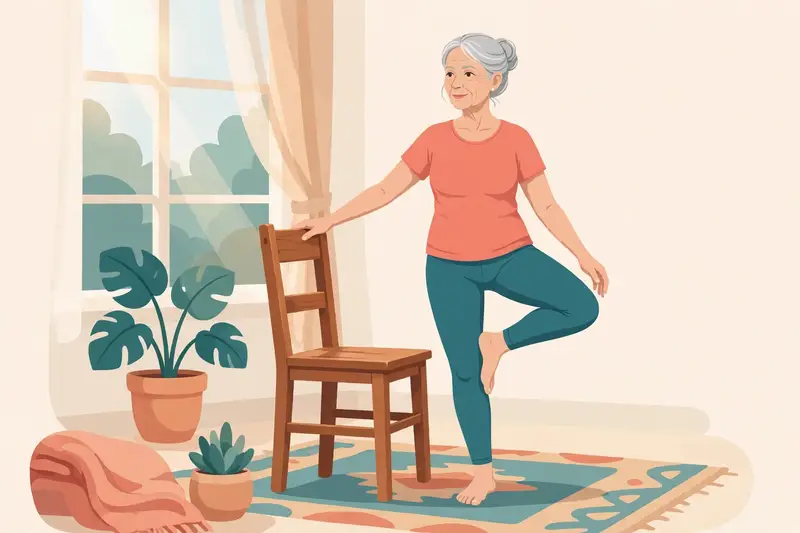
Stand beside your chair or counter with one hand resting on it. Lift one foot a few inches off the floor and hold for 10 seconds, then set it down. Repeat on the other side. Do three rounds on each leg. As this gets easier, try holding for 15 seconds, then 20 seconds. You can also try it with your fingertips barely touching the support instead of your whole hand. Standing on one leg is one of the most useful balance skills there is, because walking is really a series of tiny single-leg stands, one after another.
Marching in Place
Stand tall behind your chair, holding the back of it lightly with both hands. March slowly in place, lifting each knee to a comfortable height, for 20 slow steps. Keep your movements controlled rather than fast, and set each foot down gently. Marching builds the leg strength that supports balance, and it practices the weight shift from one leg to the other in a rhythmic, predictable way. If you feel confident, try marching with just one hand on the chair, then with your hands hovering just above it.
Seated Balance Exercises
Some days, standing practice may feel like too much, and that is perfectly fine. Seated exercises are a wonderful place to start, and they are also a good option on days when you feel tired or a little unsteady. Sitting down does not mean you are skipping your balance work. It means you are choosing the version that suits your body today, and that is exactly the right call.
Sit in a sturdy chair with your feet flat on the floor and your back away from the backrest if you can manage it comfortably. Place your hands on your thighs. Slowly lift one foot a few inches off the floor, hold it for 5 seconds, and set it back down. Repeat on the other side. Do five lifts on each foot. This gentle movement wakes up the muscles in your thighs and ankles, and it practices the same weight shift you use when you walk, only from a safer seated position.
Next, try seated marching. With your feet on the floor, lift your right knee a few inches, set it down, then lift your left knee. Keep the movement slow and steady for 10 lifts on each side. You can hold the sides of the chair if you like. Seated marching is a kind, low-pressure way to build leg strength, and strong legs are one of the best friends your balance can have.
Another useful seated exercise is the gentle torso turn. Sit tall with your feet flat and your arms crossed lightly over your chest. Slowly turn your upper body to the right, hold for 3 seconds, and return to the center. Then turn to the left and hold for 3 seconds. Repeat four times on each side. This movement practices the kind of turning you do when you reach for something beside you, and it trains your core muscles to support you while you move.
If you enjoy a fuller seated workout, you may like the gentle routines in my chair workout for women over 60, which pairs well with these balance exercises and uses the same sturdy chair you already have. Building strength while seated is a practical way to support your balance without putting extra pressure on your knees or your confidence.
Using a Chair or Counter for Support
Let me say something clearly, because I think it needs saying: using support is not cheating. A chair or a counter is a tool, just like a good pair of shoes. Professional dancers hold a barre when they practice. Physical therapists put a chair beside their clients. There is no reason you should feel embarrassed about keeping a hand near something solid while you practice.
The trick is to use support wisely. At first, rest your whole hand on the counter and let it carry as much of your weight as you need. As an exercise starts to feel familiar, try resting just your fingertips on the surface. Then try hovering your hand an inch above it, so it is there if you need it but you are not leaning on it. This slow progression lets your balance system take on a little more work each time, without ever leaving you unprotected.
Choose your support carefully. A kitchen counter is ideal because it is fixed to the wall and will not slide. A heavy dining table works too. A sturdy chair with a solid back is good, but make sure it cannot tip or slide away from you. Place it on a rug with a non-slip backing, or directly on the floor. Avoid rolling chairs, lightweight folding chairs, and anything with wheels. If you are not sure a piece of furniture is steady, test it with a firm push before you lean on it.
It also helps to practice in the same spot each day. When you know exactly where your counter is, how far away the chair sits, and where the light falls, you can relax and focus on the exercise instead of your surroundings. Familiarity is calming, and calm muscles balance better than tense ones. Over time, that familiar corner of your kitchen may become your favorite little practice studio.
A Simple Ten Minute Daily Routine
Here is a routine that pulls everything together in about ten minutes. You can do it once a day, ideally at a time when you feel most alert. Many women like the morning, after breakfast, when energy is fresh. Others prefer the afternoon, when the house is quiet. Pick the time that works for you, and try to keep it regular, because a habit is easier to keep than a decision you have to make fresh every day.
Start with one minute of gentle marching in place behind your chair, holding on lightly. This warms up your legs and wakes up your balance system. Then spend two minutes on the feet together stand, holding for 20 to 30 seconds at a time and resting between rounds. Follow that with two minutes of weight shifts side to side, moving slowly and breathing evenly.
Next, spend two minutes on the single leg stand, holding each leg for 10 to 15 seconds, with a hand on the counter. Then do two minutes of heel to toe standing, 15 to 20 seconds on each side. Finish with one minute of seated marching or gentle torso turns to cool down, and take a few slow, deep breaths before you walk away.
If ten minutes feels like a lot at first, start with five. Do the marching, the feet together stand, and the weight shifts, and stop there. Add one new exercise each week until you reach the full routine. Progress is progress, no matter how small it looks. The women who see the most improvement are rarely the ones who do the most in a single day. They are the ones who do a little, most days, for months at a time.
It can help to pair your balance practice with something you already do every day. Practice while your morning coffee brews, or while you wait for the kettle to boil. Tie it to an existing habit, and it stops feeling like one more task on your list. Before long, those ten minutes will feel as natural as brushing your teeth.
Progressing Safely, One Small Step at a Time
Progress in balance training is quiet and gradual. You may not notice it from one day to the next, but after a few weeks you might realize that you stood on one foot a little longer, or that you reached for a shelf without thinking about it first. That is real progress, and it deserves to be celebrated, even if no one else sees it.
When an exercise starts to feel easy, make it a little harder in a small, controlled way. Hold a position for 5 seconds longer. Move your hand from a full grip to fingertips. Stand a little farther from the counter. Close your eyes for just two or three seconds during the feet together stand, with your hand still on the counter, and open them again. Only change one thing at a time, and only when the current version feels steady and comfortable.
There are also a few ways to make exercises harder that you should avoid. Do not practice on a wobbly surface, a cushion, or a balance board unless a health professional has suggested it for you specifically. Do not close your eyes while standing on one leg without support nearby. Do not add weights or ankle weights to balance exercises without guidance. And never practice balance exercises when you feel very tired, unwell, or rushed. A skipped day is better than a fall.
Keep a simple note of your progress if you like. Write down how many seconds you held your single leg stand each week, or how many rounds you completed. Seeing those small numbers grow over a month or two is encouraging, and it reminds you that your effort is paying off. If progress seems to stall for a while, that is normal too. Bodies do not improve in a straight line. Stay patient, keep showing up, and trust the process.
Balance in Everyday Life
The real test of your balance is not what happens in your kitchen practice corner. It is what happens in the rest of your life. The good news is that everyday life is full of chances to practice balance without setting aside extra time, and these small moments add up more than you might think.
When you are waiting in line at the store, try standing with your feet together for a few seconds, holding your bag in one hand. When you brush your teeth, stand on one foot for a few seconds while you hold the counter with your free hand. When you walk down a hallway, practice placing one foot directly in front of the other for a few steps, like a slow heel to toe walk, with a wall nearby. These tiny practices fit into moments that would otherwise just pass by.
Your home can also be set up to support your balance. Keep walkways clear and well lit, especially the path to the bathroom at night. A night light in the hallway is a small investment that makes a real difference. Wear shoes with good grip around the house, and consider a non-slip mat in the shower. If you have loose rugs, fasten them down or remove them. These changes are not about making your home look different. They are about making it safer to move through.
Outdoors, give yourself permission to slow down. Wear sensible shoes for uneven ground, use a walking stick or trekking poles on trails if they help you feel steady, and take the handrail on stairs even when you think you do not need it. There is no prize for rushing. Walking at a pace that lets you notice the ground under your feet is a form of balance practice in itself, and it lets you enjoy the walk instead of worrying through it.
Regular walking is one of the best companions to balance work, because it practices weight shifting with every step. If you enjoy walking, you may like the ideas in my walking for weight loss for women article, which covers pace, distance, and making walking a comfortable daily habit. Walking and balance practice support each other beautifully, and together they keep your legs strong and your steps confident.
Pairing Balance With Strength, Flexibility, and Calm
Balance does not work alone. It is part of a team that includes strength, flexibility, and the calm that comes from moving with ease. When your leg muscles are strong, they can catch you quickly when you wobble. When your ankles and hips are flexible, they can adjust to uneven ground. When your breathing is slow and steady, your body stays relaxed enough to respond well. That is why balance training works best as part of a rounded routine rather than a standalone effort.
Strength training is a natural partner for balance work. Strong thighs, calves, and glutes give you the power to recover from a misstep, and a strong core helps you stay upright when you turn or reach. If you would like to build that strength gradually, my strength training for women over 60 guide walks through simple, safe exercises you can do at home with light weights or your own body weight. Even two short strength sessions a week can make a noticeable difference in how steady you feel.
Flexibility matters too. Tight ankles make it harder to adjust your footing, and stiff hips make it harder to shift your weight smoothly. Gentle stretching after your balance practice, when your muscles are warm, helps keep your joints moving freely. My stretching routine for women over 40 offers simple stretches you can do in a few minutes, and many of them work just as well in your sixties and beyond. A few minutes of stretching is a kind way to finish your routine.
And then there is yoga, which blends balance, strength, flexibility, and calm breathing into a single practice. Standing yoga poses, done slowly and with a chair nearby for support, are essentially balance exercises in disguise. If you are curious, my yoga at home for women over 40 article explains how to begin gently at home, with modifications that keep every pose safe and comfortable. You do not need to be flexible to start yoga. You only need to be willing to move slowly and listen to your body.
You do not need to do all of these things at once. If balance practice is your starting point, that is plenty. Add a little strength work one week, a little stretching the next, and let your routine grow at a pace that feels good. The goal is a body that feels capable and a mind that feels at ease, not a schedule that feels overwhelming.
A Gentle Word About Fear of Falling
I want to speak honestly about something many of us feel but rarely say out loud: the fear of falling. If you have fallen before, or watched a friend fall, it is natural to feel nervous about your footing. That fear is your body trying to protect you, and it deserves respect, not embarrassment. The problem is that fear can make us move less, and moving less can make us weaker and less steady, which feeds the fear all over again.
The way out of that circle is not to ignore the fear, but to work with it gently. Practice in a safe place, with support close by, and choose exercises that feel manageable. Notice the moments when you feel steady, and let those moments build your confidence. Talk to your doctor about your concerns, especially if you have fallen before or if your fear is keeping you from doing things you enjoy. A doctor, or a physical therapist if you are referred to one, can help you understand your own risk and give you exercises suited to your situation.
It also helps to talk to other women about it. You may be surprised how many of your friends share the same worry. Practicing together, even over the phone or on a video call, can make the whole thing feel lighter. A little laughter while you wobble beside your kitchen counter is good medicine, and encouragement from a friend can carry you through the weeks when motivation dips.
Remember that the goal here is not to be fearless. The goal is to feel steadier, to trust your body a little more, and to keep doing the things that matter to you. Fear shrinks when you have a plan and a little practice behind you. Ten minutes a day is a modest plan, but it is a real one, and it belongs to you.
Your Next Ten Minutes Start Now
So here is my invitation to you. When you finish reading this article, stand up beside your kitchen counter and try the feet together stand for 20 seconds. That is all. One small exercise, one moment of noticing how your body feels. If it feels good, try the weight shifts. If it feels wobbly, sit down, smile at yourself for trying, and try again tomorrow. You have just taken the first step, and the first step is the only one that matters today.
Balance is not a gift you either have or you do not. It is a skill you can practice, a habit you can build, and a kindness you can offer yourself. You have spent a lifetime looking after other people. These ten minutes are for you. They are a way of saying that your independence, your confidence, and your freedom to move through the world matter, and that you are worth the effort.
I will be practicing right alongside you, one wobble at a time, holding my counter and breathing slowly. Some days will feel steadier than others, and that is fine. What matters is that we keep showing up, keep practicing, and keep trusting that our bodies can learn. Here is to steadier steps, calmer mornings, and many more years of walking through life on your own two feet.
This article is general information only and is not medical advice. It is not a substitute for professional help. Please talk with your doctor before starting a new exercise routine, especially if you have a health condition, and stop any exercise that causes pain or dizziness.